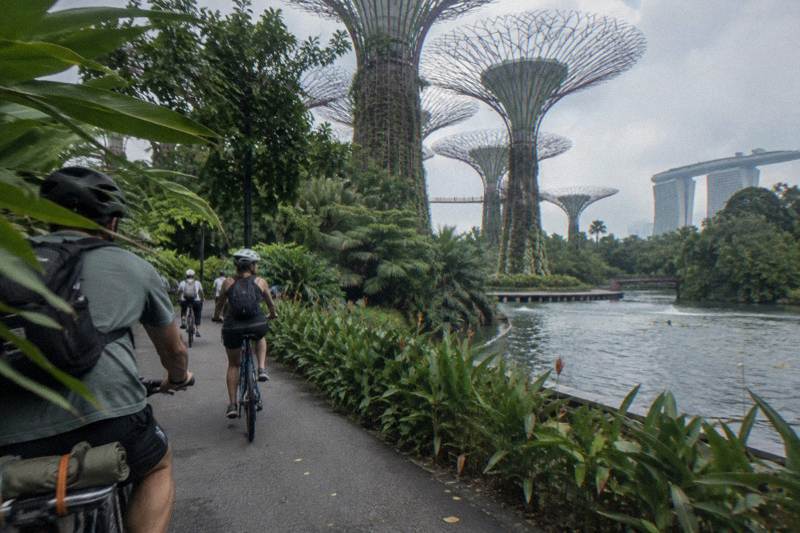
Anywheel Singapore: Zones, Parking Rules And How To Unlock
Anywheel is one of two licensed shared-bike operators in Singapore, but the system only works if you know where the bikes can go, where they must end up, and what a misplaced one costs.
Short answer
Anywheel is a licensed dockless bike-share operator in Singapore. You unlock a bike through its app by scanning a QR code, ride it on cycling paths, shared paths and roads, and finish by parking inside a designated zone and scanning that zone's QR code. A misplaced bike costs a $5 operator penalty.
Anywheel is one of only two bicycle-sharing operators licensed by Singapore's Land Transport Authority, and its fleet is a familiar sight clipped into QR-marked parking bays outside MRT stations, hawker centres and park connector entrances. The system is simple once the rules are understood: an app finds the bike, a QR code releases the lock, and a second QR code at a designated parking zone ends the trip. What trips up visitors is everything around the ride, namely where the bike may legally go, where it must be returned, and what a careless return costs. Pricing is the other half of the picture, so before you set off, check how much a ride actually costs per hour with our guide to Anywheel's hourly pricing.
This page walks the whole loop, from unlocking to parking to the penalty that follows a bad park. It also makes the case for letting someone else handle the logistics, because a guided ride such as the Lion City Bike Tour of Singapore hands you a fitted bike, a licensed local guide and a route that needs no QR code at all. If you'd rather skip the app and rent on your own terms, this guide to bike rentals for visitors explains what shops require and which rules apply.
What Is Anywheel In Singapore?
Anywheel is a dockless bicycle-sharing operator licensed by Singapore's Land Transport Authority, one of only two operators holding that licence. Bikes are located through the operator's app, unlocked by scanning a QR code on the frame, and paid for inside the app. Every trip must end in a designated parking zone, closed out by scanning that zone's own QR code.
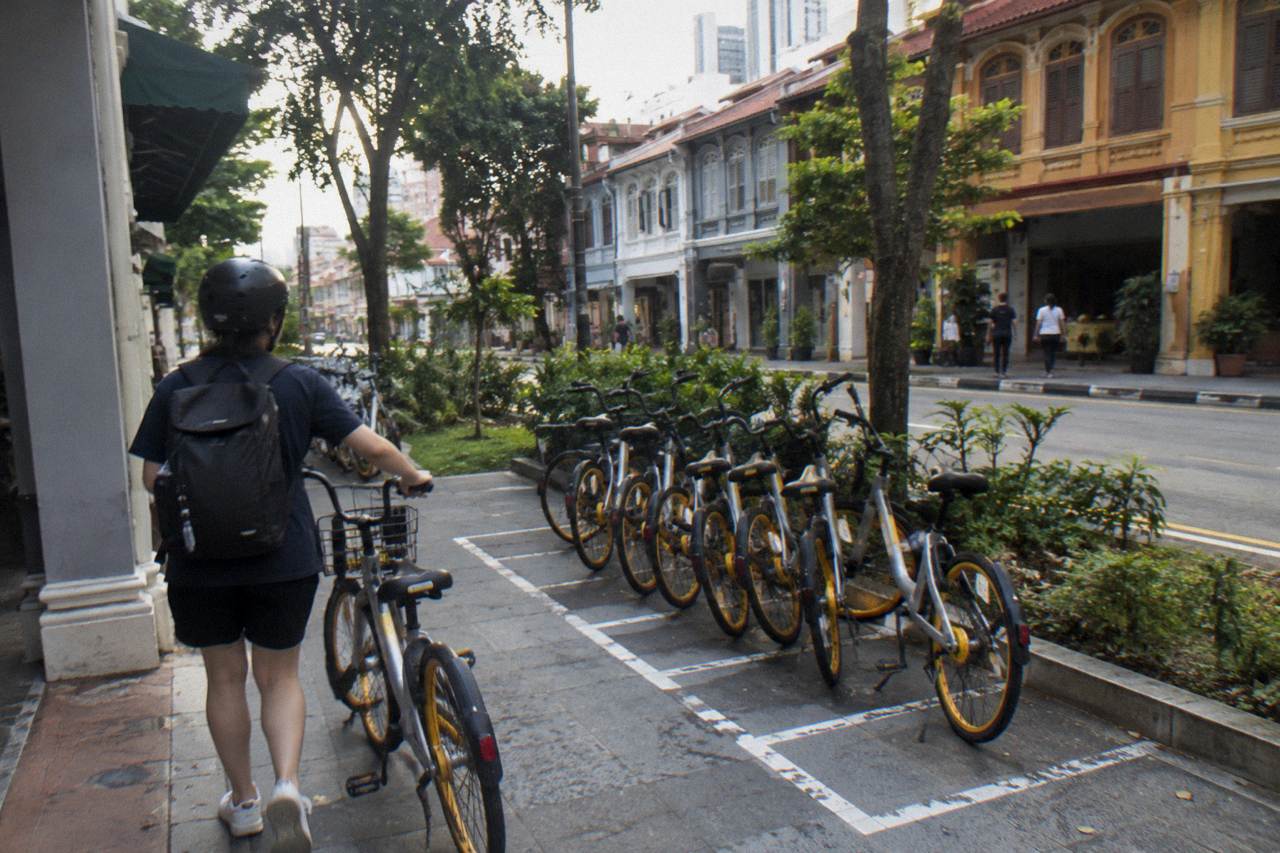
Dockless means exactly what it says: the bikes carry their own locks and have no home dock. A rider can pick one up wherever the previous rider left it, provided that spot was a legal parking zone, and drop it at any other zone rather than at a fixed station. That flexibility is the entire appeal. A visitor staying in a hotel near an MRT station can ride to a hawker centre, a park connector or a museum and leave the bike in a marked bay a short walk from the door.
The licence matters more than it might sound. Only two bicycle-sharing operators hold LTA licences in Singapore, under a fleet cap. Only Anywheel and HelloRide hold that permission today. Riding an unlicensed or personal bike carries none of this structure, and renting from a shop carries a different structure again, which is why the broader Singapore bike sharing explained page separates the three models in detail.
One point that saves confusion at the bay: these are regular pedal bicycles, not electric ones. Power-assisted bicycles in Singapore carry their own registration, age and theory-test requirements, and no guided tour on this site uses them either. If a hill looks intimidating, the honest answer is gears and timing, not a motor. Curious what it would take to ride one anyway, our guide to electric bike rental rules in Singapore explains the paperwork and where regular-bike rides fit in.
How Do You Unlock An Anywheel Bike In Singapore?
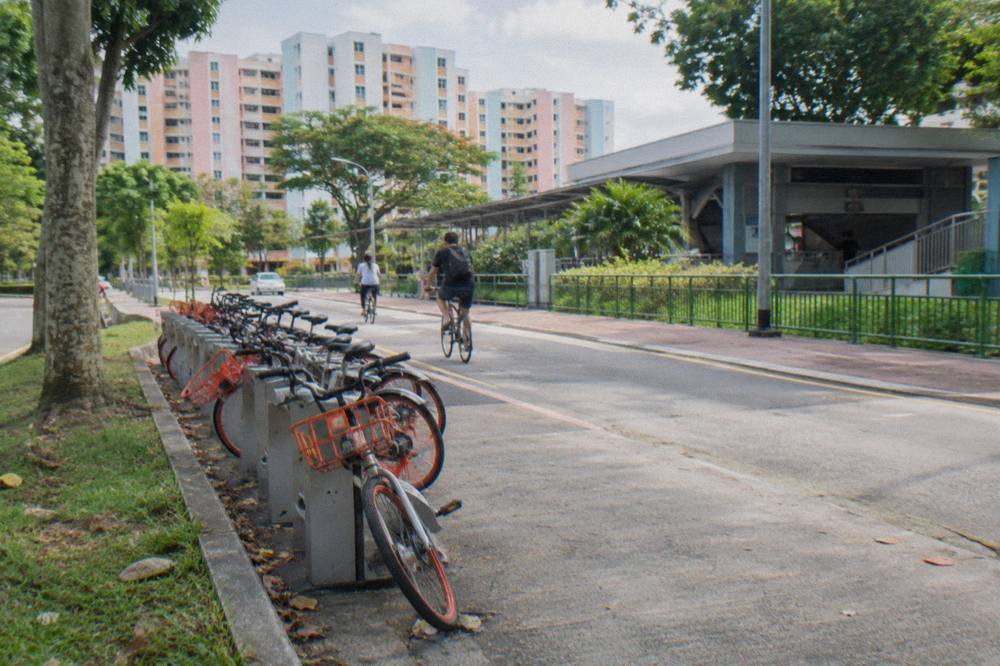
Unlocking is entirely app-based. Download the operator's app, create an account with a payment card or PayNow, find the nearest bike on the map, and scan the QR code printed on the frame to release the lock. To finish, push the bike into a designated parking zone and scan that zone's QR code in the app so the trip closes. Look for Anywheel and HelloRide bikes on Sentosa.
The unlock sequence takes under a minute once the app is installed. The map view shows every available bike nearby, usually as pins clustered around MRT exits and park entrances. Tapping a pin reserves nothing by itself; the reservation happens when the QR code is scanned and the lock pops open. Payment runs through the same app, so the whole transaction lives on one phone.
Ending the trip is where newcomers lose money. The lock closing is not the end of the rental in the operator's eyes; the trip only ends when the bike is inside a designated parking zone and the zone's QR code has been scanned. A rider who leans the bike against a wall, walks away and assumes the timer stopped can return to an open trip and a penalty. The app shows nearby zones on the same map that showed the bikes, so the habit to build is a two-step finish: park inside the painted bay, then scan the zone's code before walking off.
The natural question that follows is what all this costs per hour or per day, and that question now has a page of its own: what Anywheel charges per hour works through the pricing model without guessing at figures that shift with promotions.
For some visitors, even a smooth unlock is friction they would rather skip on a tight itinerary. The three rides below are the guided formats most often compared against a self-guided shared-bike day, and each hands you a bike, a guide and a route with no app required.
Where Can You Ride An Anywheel Bike In Singapore?
An unlocked Anywheel bicycle may be ridden on cycling paths, shared paths and most public roads, at a maximum of 25 km/h on the path types and 10 km/h on footpaths that remain open to bicycles. It must not be taken on expressways or road tunnels, and it must never be ridden on a Pedestrian-Only Path beside a cycling path.
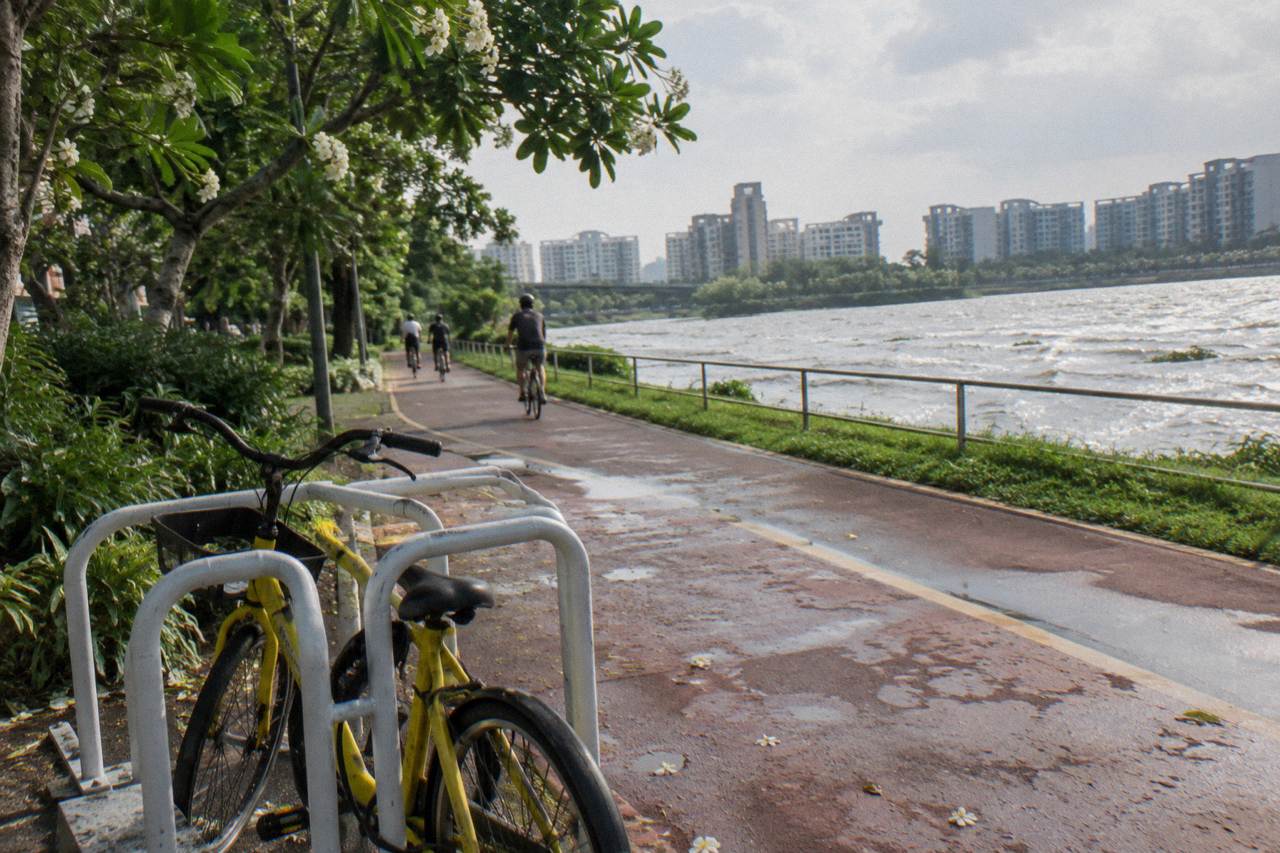
Singapore's path network is colour-coded, and the code is worth learning before the first ride. Cycling paths carry a red or dark grey surface with a cyclist logo and a 25 km/h ceiling. Shared paths are marked with both a cyclist and a pedestrian logo, carry the same 25 km/h ceiling, and expect riders to give way to people on foot. Ordinary footpaths beside roads and inside housing estates allow bicycles at 10 km/h, except where a footpath next to a cycling path has been converted to a Pedestrian-Only Path, which bans bicycles outright. The LTA's code of conduct sets out the full rule set, and the NParks path typology covers the park-side markings.
| Path type | Typical marking | Bicycles | Speed limit |
|---|---|---|---|
| Cycling path | Red or dark grey surface, cyclist logo | Allowed | 25 km/h |
| Shared path | Cyclist and pedestrian logos | Allowed, give way to pedestrians | 25 km/h |
| Footpath | Unmarked path beside roads or in estates | Allowed where not converted | 10 km/h |
| Pedestrian-Only Path | Marked beside a dedicated cycling path | Prohibited | No bicycles |
| Road | Non-expressway roads | Allowed, helmet mandatory | Road speed limit |
The park connectors that thread the island follow the same logic with local additions. Shared-path stretches carry continuous red lines that turn dotted near Attention Zones at bus stops, crossings and playgrounds, where the expectation is a slow bike and a yielding rider. Segregated stretches split pedestrians onto a 10 km/h footpath from faster wheeled traffic on a red-lined cycling lane. Riders are asked to keep left, use lights after dark, and in NParks' own advice, wear a helmet on the connectors even though the legal helmet mandate applies to roads.
A handful of places simply do not admit bikes at all: the gazetted nature reserves, Henderson Waves, the Forest Walk at Telok Blangah, the boardwalks at Pasir Ris and Coney Island, and the Botanic Gardens among them. None of this is hostile to cycling; it is a reminder that a shared bike is a utility vehicle for streets and connectors, not a trail bike for boardwalks.
For a visitor, the honest weighing is time against confidence. A shared bike is cheapest for a solo half-hour hop between two points. The moment the plan involves a route worth following, a story worth hearing or a photo worth stopping for, a guide starts earning their fee, and the rides on this site all include the bike.
What Happens If You Park An Anywheel Bike Outside A Designated Zone In Singapore?
Parking outside a designated zone carries a $5 penalty fee charged by the operator, and riders who do it repeatedly can be banned. About 95 percent of shared-bike trips already end inside designated areas. The rule exists because dockless bikes abandoned on footpaths generate complaints, and the operators answer for it under their licences.
The $5 fee is not a government fine. It is a penalty the operator charges the rider's account directly, and the Ministry of Transport has confirmed the mechanism publicly in its response on shared-bicycle parking complaints and fines. Repeat offenders can lose access to shared bikes under the rules on improper parking. The practical fix is one habit: never end the app session until the bike is inside the painted bay and the zone's QR code has scanned.
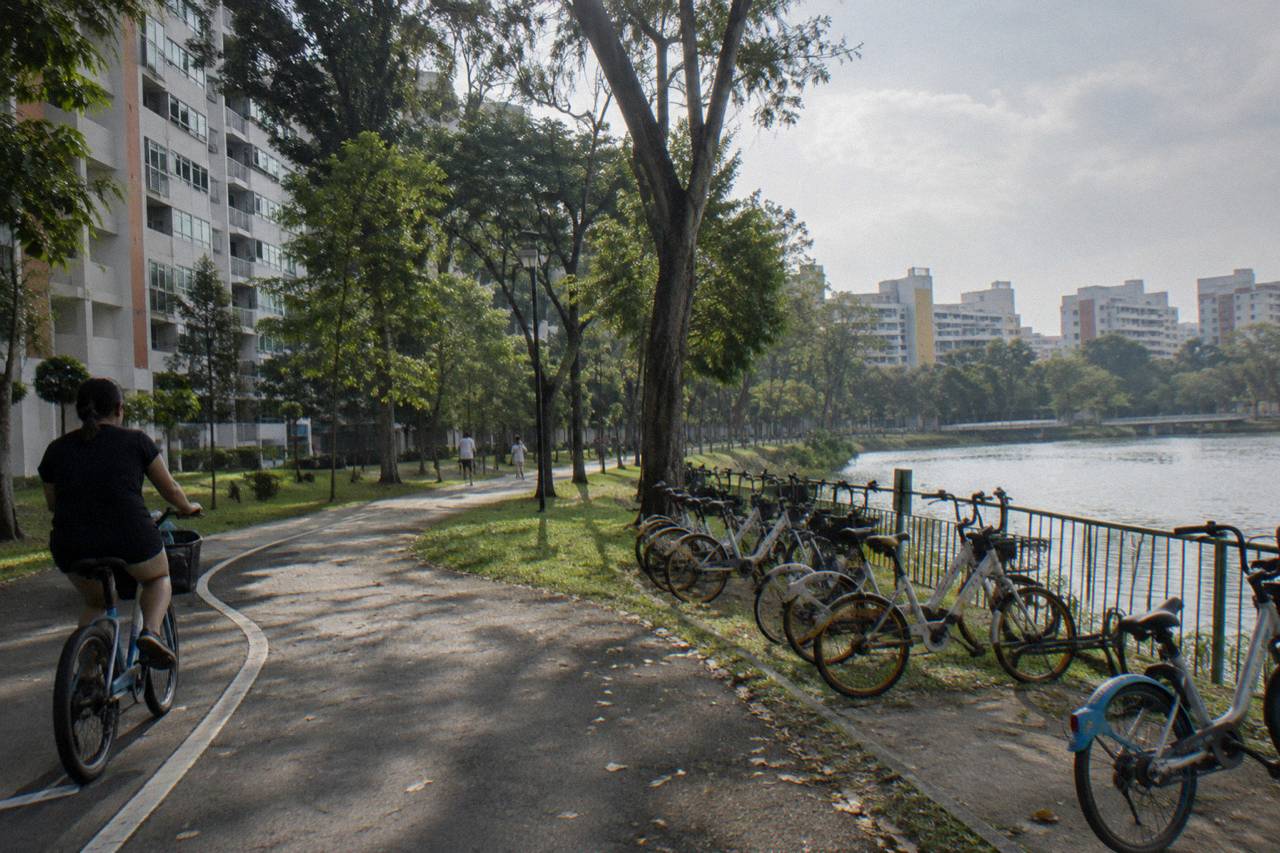
Why so strict? Singapore licenses its shared-bike operators, and Anywheel currently holds a fleet licence with a cap of 35,000 bicycles. The designated-zone system is the compromise that keeps dockless sharing alive at all: riders get flexibility, the city gets predictable parking, and the operator carries the cost of enforcement. A tourist who parks badly pays $5; an operator who lets bikes pile up risks far more.
- Bike23 of 23
- Guide19 of 23
- Drinks14 of 23
- Helmet11 of 23
- Meal or food stop8 of 23
A listing that does not mention an item is not counted as leaving it out.
The same logic covers where a bike may be pushed, not just parked. At a "No Riding" sign the device must be walked, not ridden, and in crowded areas the code of conduct asks riders to dismount entirely. None of this is enforced with menace, but enforcement is real, and a shared bike with an operator logo on the frame is an easy target for a spot check.
How Does Anywheel Compare With HelloRide In Singapore?
Anywheel and HelloRide are the only two licensed shared-bike operators in Singapore, and the systems are close twins. Both unlock through an app and a QR code, both require parking in designated zones, and both charge the same $5 improper-parking penalty through the operator. The differences sit in app integration and hardware, not in the rulebook.
Both apps follow the same shape: a map of nearby bikes, a scan-to-unlock flow, in-app payment and a zone scan to finish. HelloRide bikes add NFC tap-to-ride in some cases and can be reached through a ride-hailing app's integration, which is convenient for a visitor who already lives inside that ecosystem. Anywheel's app stands on its own. Neither system requires a local bank account; card payment works for visitors.
| Anywheel | HelloRide | |
|---|---|---|
| Licence | LTA-licensed shared-bike operator | LTA-licensed shared-bike operator |
| Unlock | App and QR code scan | App and QR scan, NFC tap on some bikes |
| App access | Own app | Own app, ride-hailing integration in some cases |
| End of trip | Park in zone, scan zone QR | Park in zone, scan zone QR |
| Improper parking | $5 operator penalty, repeat bans | $5 operator penalty, repeat bans |
| Fares | Priced in the app | Priced in the app |
On price, no figures are printed here because the per-trip fares live in the apps and shift with promotions, which is precisely the kind of number a comparison page should not guess at. The head-to-head on cost has its own write-up in the Anywheel or HelloRide price comparison, and HelloRide's side of the story gets a full treatment on the HelloRide Singapore page.
The deeper truth is that the operator barely matters for a short visitor stay. Availability at your actual starting point matters more, because an empty zone beats a superior app every time. Open both maps on arrival, see which brand has bikes near the hotel, and the decision usually makes itself.
Is A Guided Bike Tour In Singapore Better Than Bike Sharing?
A guided tour costs more than a shared bike but removes every step this page describes. The bike is provided and fitted, a licensed guide picks the route, and parking, zones and unlock codes become the operator's problem. Guided rides run from 2 to 8 hours and from $47 to $224.11 per person, depending on the format.
- Up to 2 hours4 tours
- 3 to 4 hours17 tours
- 5 to 6 hours1 tour
- 7 hours or more1 tour
The comparison is not really about money. A few hours on a shared bike costs pocket change against any tour price. The comparison is about what the hours contain: a shared-bike day asks you to plan a route, watch path markings, carry water and end every leg at a zone QR code, while a guided day hands all of that to someone who does it for a living.
| Ride | Duration | Reviews | From per person |
|---|---|---|---|
| Full-Sized Bikes, Small Group | 4 hours | 5.0 across 1,559 reviews | $64.03 |
| Marina Bay Night Ride, 2 Hours | 2 hours | 4.9 across 598 reviews | $48.02 |
| Small Group, Max 10 Guests | 4 hours | 4.8 across 74 reviews | $64.03 |
| Licensed Guide, Poncho Included | 4 hours | 5.0 across 6,579 reviews | $68.03 |
The small-group formats are where a shared bike loses first. The Full-Sized Bikes, Small Group ride from Lets Go Tour Singapore runs four hours with a licensed local guide, a local snack and a local drink, bottled water, a rain poncho and bag storage, for from $64.03 per person, with the group capped at 15. Water, poncho and storage are exactly the three things a shared bike never provides, and the snack is the fourth.
For a short evening, the Marina Bay Night Ride, 2 Hours covers the same operator's two-hour format, from $48.02 per person, rated 4.9 across 598 reviews, with helmet, bottled water, poncho and locker storage included. Two hours is the natural length after dinner, and Marina Bay after dark is the one Singapore view that justifies a bike between stops.
City Scoot's Small Group, Max 10 Guests format is the tighter alternative: four hours, from $64.03 per person, rated 4.8 across 74 reviews, with bicycle, helmet, bottled water, a raincoat and bag storage in the shop, and a strict ten-rider cap that keeps the group conversational. The meeting point at Esplanade Mall puts riders a short roll from the Marina Bay loop from the first minute.
Then there is the ride this site features alongside this comparison, the Lion City Bike Tour run by Bike Around Tour Singapore: four hours, $68.03 per person, rated 5.0 across 6,579 reviews, with a licensed local guide, a bicycle and a disposable poncho included. It is rain or shine, helmets are available on request, and luggage storage can be arranged by email in advance. Full details and dates are on the Lion City tour page, and check availability there before you commit to a shared-bike day instead.
The trade collapses in favour of the shared bike in exactly two cases: a solo traveller with time to kill and a two-point errand, or a local commute. A visitor with two days in the city and a list of things worth seeing is neither, and the rest of Singapore Bike Tours exists for that reader.
When Is The Best Time To Ride Anywheel In Singapore?
The driest, brightest window runs from late February into March, after the monsoon peak. February averages 105.1 mm of rain across 8.5 rain days and 7.0 sunshine hours a day, against November's 252.3 mm across 19 rain days. Early morning beats midday heat at any time of year, and every month stays rideable with a poncho.
Singapore has no month that closes to cyclists. The differences are degrees of wet: the Northeast Monsoon makes November to January the soggiest stretch, with December the wettest of all at 331.9 mm of rain across 19.3 rain days, while February dries out to 105.1 mm across 8.5. The figures below come from the Meteorological Service Singapore 1991 to 2020 normals for Changi.
| Month | Mean temp | Rainfall | Rain days | Sunshine h/day |
|---|---|---|---|---|
| February | 27.3 C | 105.1 mm | 8.5 | 7.0 |
| May | 28.6 C | 164.3 mm | 14.5 | 6.0 |
| November | 27.2 C | 252.3 mm | 19.0 | 4.4 |
| December | 26.8 C | 331.9 mm | 19.3 | 4.3 |
Two practical readings follow. First, equatorial showers are short and violent more often than all-day, so a two-hour gap between downpours is a normal thing to plan around, and several guided operators here describe their rides as rain or shine, with ponchos on hand. Second, heat is the steadier adversary: May is the hottest month at a 24-hour mean of 28.6 C, and daily maxima sit in the low thirties year-round, so the shared bike borrowed at 8 am is a different machine from the same bike at 1 pm.
Guided Singapore Bike Tours: Duration And Price From Comparison
Prices shown per person, as listed on this site
Timing also interacts with the parking rules. Zones near MRT stations empty and fill with commuter rhythm, so a visitor hunting a bike at 8.30 am on a weekday is competing with the morning rush for the nearest few machines. Bays fill and empty quickly, so plan a little slack into your ride time.
Common Questions About Anywheel In Singapore
What Is Anywheel In Singapore?
Anywheel is one of two dockless bicycle-sharing operators licensed by Singapore's Land Transport Authority. Bikes are found on the operator's app, unlocked by scanning a QR code, and returned to designated parking zones, with the trip closed by scanning the zone's QR code.
How Do You Unlock An Anywheel Bike In Singapore?
Download the operator's app, create an account with a payment method, find the nearest bike on the map, and scan the QR code on the frame. The lock releases and the trip starts. To finish, park inside a designated zone and scan that zone's QR code so the trip ends.
Where Can You Ride An Anywheel Bike In Singapore?
Cycling paths and shared paths at up to 25 km/h, footpaths open to bicycles at up to 10 km/h, and most non-expressway roads with a helmet on. Pedestrian-Only Paths beside cycling paths are off limits, as are nature reserves and the marked boardwalks where cycling is not allowed.
What Happens If You Park An Anywheel Bike Outside A Designated Zone In Singapore?
The operator charges a $5 penalty fee to the rider's account. Riders who repeatedly park shared bikes improperly can end up banned from using them. About 95 percent of shared-bike trips already end inside designated zones, so legal bays are rarely far away.
How Does Anywheel Compare With HelloRide In Singapore?
Both are licensed, both unlock by app and QR code, both use designated parking zones, and both charge the same improper-parking penalty. HelloRide adds NFC tap-to-ride on some bikes and a ride-hailing app integration in some cases; Anywheel runs on its own app.
Is A Guided Bike Tour In Singapore Better Than Bike Sharing?
For a visitor with a list of things to see, usually yes. Guided rides from $47 to $224.11 per person include the bike, a licensed guide, and often water, ponchos and storage, removing the route planning and the parking rules entirely. A shared bike wins only on price for short point-to-point hops.
If a self-guided day on a shared bike still appeals after all of that, the workflow above is everything you need: scan to unlock, ride the right paths at the right speeds, and finish inside a painted bay with the zone's code scanned. If it sounds like logistics rather than a holiday, the three rides below each hand back the hours a QR code would take.