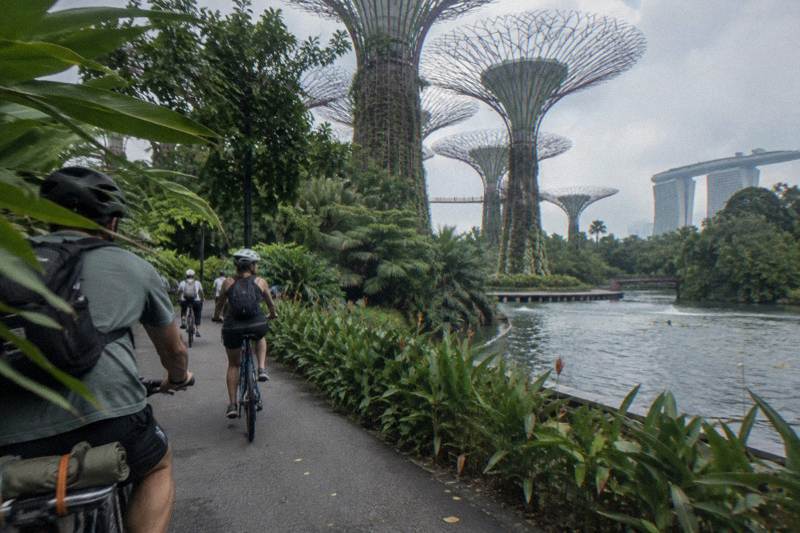
Is Singapore Good For Cycling?
A straight answer on whether Singapore works as a cycling city: path types, speed limits, weather, the rules visitors must follow, and the guided rides that make the decision easy.
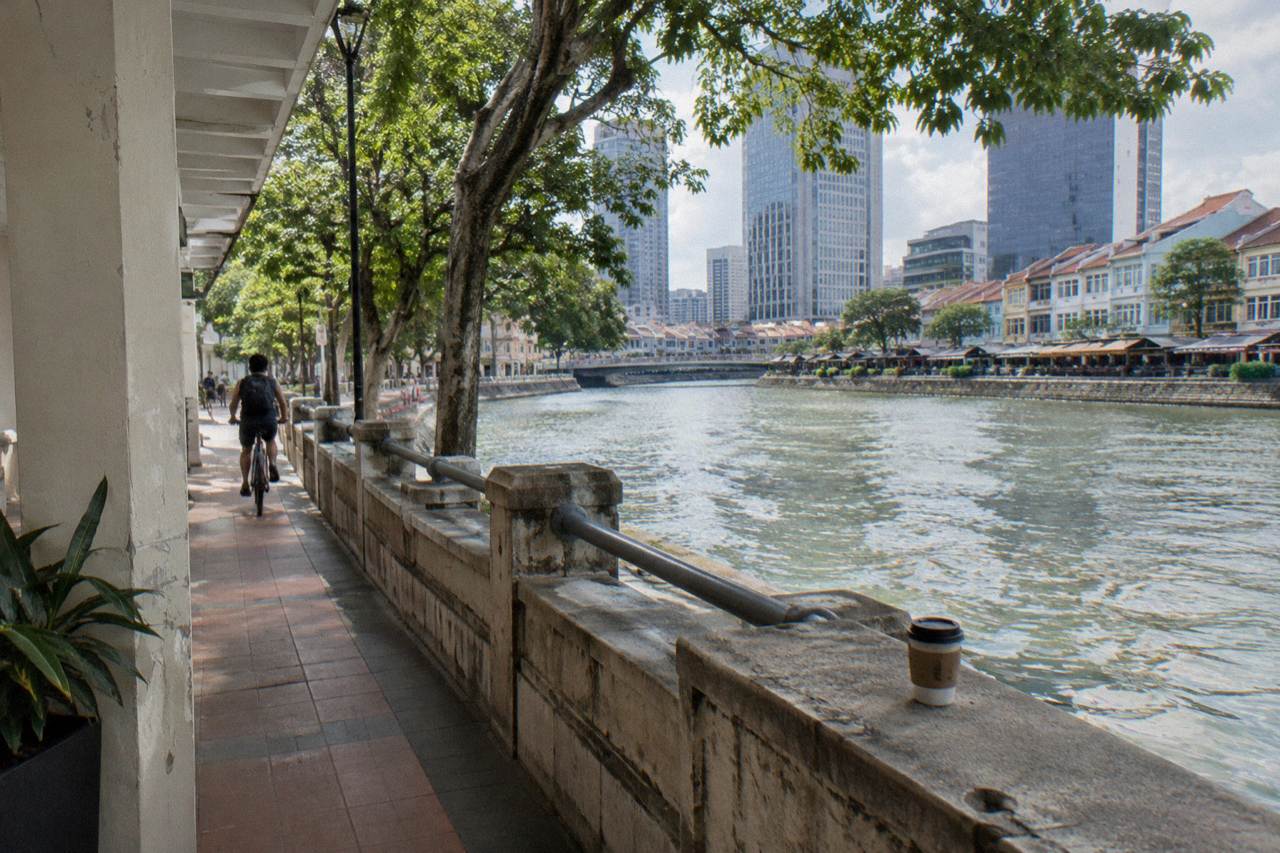
Yes, with conditions. Singapore maintains over 350 km of park connectors plus dedicated cycling paths and shared paths around most major districts, which is more separated cycling infrastructure than most cities of its size offer. The conditions are the climate, the path rules and the law that keeps bicycles off certain footpaths, and a guided ride such as the four-hour Lion City Bike Tour sidesteps nearly all of them.
That is the honest short version. The longer version is that Singapore spent two decades building a network of off-road routes, the Park Connector Network, that links parks, rivers, reservoirs and coastlines into something a visitor can actually ride end to end. NParks describes more than 350 km of park connectors, and the Round Island Route project, a planned continuous 150 km route that is part of a 360 km island-wide recreational network, already has a 75 km eastern phase open from Rower's Bay past the Singapore River to Berlayer Creek.
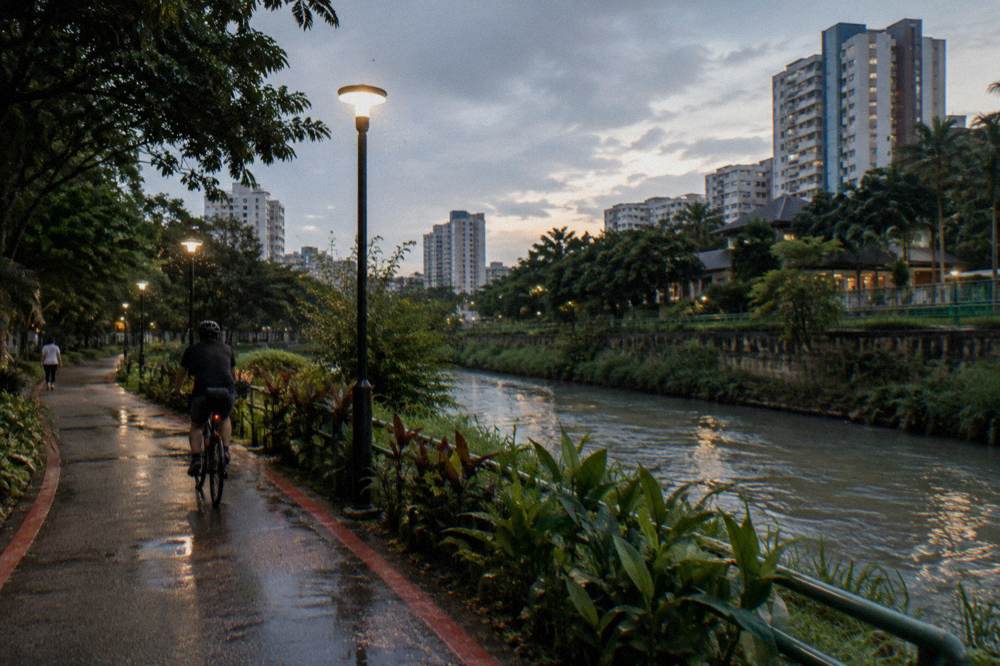
What makes the city unusual is not just the distance. It is that the paths are surfaced, signposted, lit at night in most stretches and deliberately separated from traffic. A rider can cross from Marina Bay to the eastern coast without touching a road except at signed crossings. That is the core of the answer to this question, and it is why the most reviewed ride on the site, the Lion City Bike Tour from Bike Around Tour Singapore, rated 5.0 across 6,579 reviews from $68.03 per person, spends four hours almost entirely away from cars.
“The Singapore Night to Light tour was fantastic. We did this tour as the first thing we did when arriving in Singapore - and it greatly helped us get our bearings. Alvin, our guide had lots of local knowledge and knew the best locations for photo opportunities. He was excellent and I highly recommended this tour.”
The catch is what those paths ask of the rider. Singapore is hot by any standard, with an annual mean temperature around 28 degrees Celsius and daily maxima that sit in the low thirties most of the year. Rain is not an occasional hazard, it is a scheduled feature of the calendar: the Meteorological Service Singapore 1991 to 2020 normals for Changi put November and December at 252.3 and 331.9 mm of rainfall respectively, with roughly 19 rain days each. And the rules, enforced under the Active Mobility Act and tightened as recently as July 2025, are specific about where a bicycle may go and how fast it may travel.
A reader deciding whether the city suits a ride is really deciding three smaller things at once: whether the infrastructure holds up across a whole route, whether the weather makes riding unpleasant, and whether the rules are workable for someone who does not live here. Each of those has a clear answer, and the sections below take them in order.
How Safe Are Singapore's Paths For Cyclists?
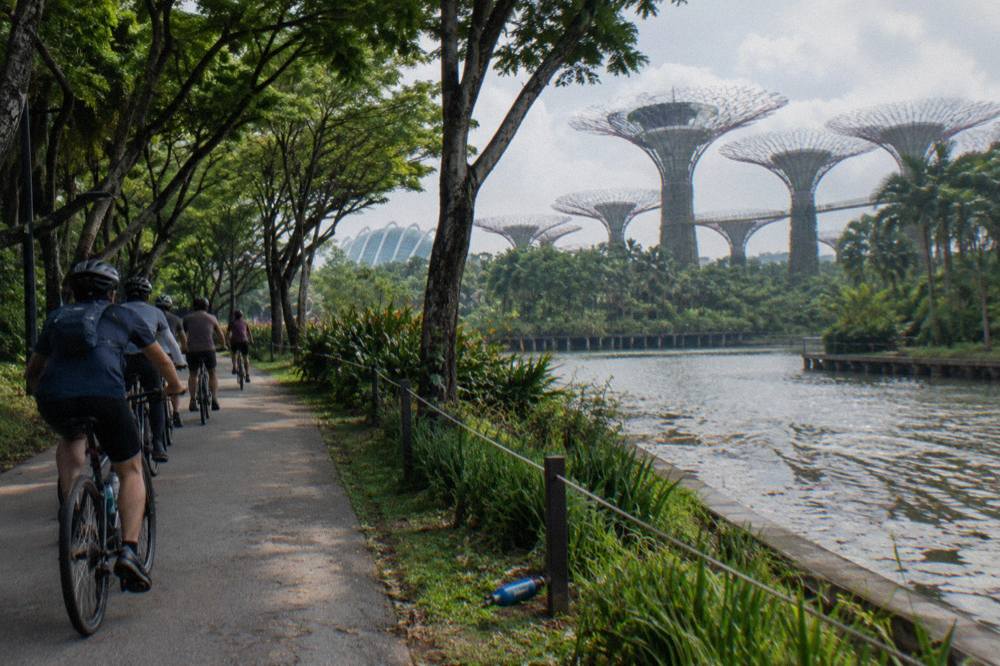
Safety on Singapore paths is high by regional standards and enforced in writing. Cycling paths and shared paths carry a 25 km/h ceiling, footpaths 10 km/h, and since 1 July 2025 bicycles are barred from footpaths converted to Pedestrian-Only Paths, with first offences carrying penalties of up to $2,000 and/or three months' imprisonment. The risk that remains is heat and pedestrian density, not vehicles.
The numbers back that up. Since 1 July 2025, the Land Transport Authority's Active Mobility Enforcement Officers have been patrolling the converted Pedestrian-Only Paths, the footpaths that run beside dedicated cycling paths, and the authority's stated position is a measured one for genuine mistakes and zero tolerance for speeding or reckless riding. The penalty attached to that specific offence, up to $2,000 and/or up to three months for a first offence, is the sharpest edge of a rules regime that otherwise reads as education-first.
The bigger everyday safety story is separation from traffic. The LTA's code of conduct sets out where bicycles may ride, and for riders on roads the helmet is mandatory, riding is single file on single-lane roads and during bus lane hours, and group rides are capped at five bicycles in single file. A guided tour almost never puts a visitor in that position, because the routes hug the park connectors and the waterfront promenades.
NParks adds its own layer on the park connector side. Its cycling guidance asks riders to give way to pedestrians, slow down in red-dotted Attention Zones at bus stops, crossings and playgrounds, keep left except when overtaking and ride in single file where the path narrows. Signs along the connectors repeat all of it in pictograms, and the network genuinely enforces its own etiquette through sheer pedestrian volume: a rider who barrels through a crowded stretch gets corrected by the geometry, fast.
None of this means the paths feel bureaucratic. What it means is that the safety case for cycling here does not rest on driver behaviour, which a visitor cannot predict, but on path design and published limits, which a visitor can read before arriving. For a fuller breakdown of the rules in practice, the visitor rules guide covers them in detail.
Does Singapore's Weather Get In The Way?
Partly, and predictably. The climate is hot year-round with mean daily maxima ranging from 30.5 to 32.4 degrees Celsius across the year, and the wettest months are November to January at roughly 19 rain days each, so morning and night rides beat afternoons on both counts. The heat is manageable and the rain is usually short, but neither is optional to plan around.
The table below is the honest version of the forecast. These are Meteorological Service Singapore 1991 to 2020 normals for Changi, the official long-run averages rather than any single year, and they say two things clearly: there is no cool season, and there is a wet one.
| Month | Mean temp C | Mean daily max C | Rainfall mm | Rain days | Sunshine h/day |
|---|---|---|---|---|---|
| Feb | 27.3 | 31.5 | 105.1 | 8.5 | 7.0 |
| May | 28.6 | 32.3 | 164.3 | 14.5 | 6.0 |
| Aug | 28.1 | 31.4 | 146.9 | 13.8 | 6.0 |
| Nov | 27.2 | 31.2 | 252.3 | 19.0 | 4.4 |
| Dec | 26.8 | 30.5 | 331.9 | 19.3 | 4.3 |
February is the driest month on the series at 105.1 mm and 8.5 rain days. November and December, the Northeast Monsoon wet phase, roughly double both figures and cut sunshine to 4.4 and 4.3 hours a day. May is the hottest month at a 24-hour mean of 28.6 degrees. The full picture, month by month, is in the best time to cycle guide.
What the averages hide is the shape of a Singapore rain day. Showers in the wet months tend to arrive as heavy bursts, frequently in the afternoon, rather than as all-day drizzle, so a ride that starts at 8 am often finishes before the sky opens. This is exactly why operators build the schedule they do: the Sunrise Ride, Local Breakfast tour from Punggol runs 3 to 4 hours from $48.02 per person with breakfast included, and the Marina Bay Night Ride from Let's Go Tour Singapore cuts the heat out entirely, a 2-hour route rated 4.9 across 598 reviews from $48.02 per person.
“This was a great way to kick off our Singapore holiday. The bike ride captured a great number of sights and the tour guide (Ben) was full of knowledge. Can’t recommend this highly enough - great, must do experience.”
The operators here treat weather as a solved problem rather than a risk. Nearly every tour on this site includes a disposable poncho in the price, from the four-hour Small Group, Max 10 Guests city ride by City Scoot, rated 4.8 across 74 reviews from $64.03 per person, to the Katong food rides. The listing descriptions repeat a phrase that sums up the local attitude: the tour is a rain or shine activity. The rain riding guide goes into what that actually feels like on a path.
One weather factor deserves its own sentence: haze. Transboundary smoke haze is common in the Southwest Monsoon months and can cut visibility sharply in severe episodes, and it is the one condition operators genuinely watch rather than shrug off. Check the hourly forecast the night before, not the monthly average.
Where Can You Ride In Singapore?
Almost everywhere a visitor wants to go, on paper and in practice. The options are cycling paths with a 25 km/h limit, shared paths at the same 25 km/h, ordinary footpaths at 10 km/h where still permitted, and the 350 km park connector network that stitches the island together, plus 12 km of designated trails on Sentosa and 10 km of mountain bike trails on Pulau Ubin.
The path types matter because the law is written around them, and because a visitor can read the ground itself. A cycling path is red or dark grey and stamped with a cyclist logo. A shared path carries both the cyclist and pedestrian logos. A footpath, the unmarked pavement beside roads and within housing estates, is the 10 km/h space. A Pedestrian-Only Path, the converted footpath next to a dedicated cycling path, is closed to bicycles outright since July 2025. More of these guides are collected on Singapore Bike Tours.
| Path type | Marking | Speed limit | Bicycles allowed |
|---|---|---|---|
| Cycling path | Red or dark grey, cyclist logo | 25 km/h | Yes |
| Shared path | Cyclist and pedestrian logos | 25 km/h | Yes |
| Footpath | Unmarked pavement | 10 km/h | Yes, where not converted |
| Pedestrian-Only Path | Pedestrian logos beside a cycling path | Not applicable | No |
| Road | Traffic signage | Road speed limit | Yes, helmet mandatory |
For route planning, the geography is generous. The eastern half of the island holds the strongest card: the Round Island Route's Phase 1 runs 75 km from Rower's Bay past Sengkang Riverside Park, Pasir Ris Park, Changi Beach Park and East Coast Park to Berlayer Creek, crossing Changi Bay on two cycling bridges totalling 140 m. The park connector overview maps the network and its named loops, and the Round Island Route guide covers the long ride end to end.
Pulau Ubin is the outlier and the reason many people answer this question with an unqualified yes. The island sits a short bumboat crossing from Changi Point Ferry Terminal and holds Ketam Mountain Bike Park, 45 hectares with roughly 10 km of trails rated by the International Mountain Bicycling Association standard across Blue Square, Black Diamond and Double Black Diamond lines. The Pulau Ubin Nature Ride by Asian Detours, rated 4.2 across 29 reviews from $84.04 per person, spends four hours out there with a guide and accident insurance included.
There are places bicycles may not go, and they are posted: the four gazetted nature reserves, Henderson Waves bridge, the Forest Walk at Telok Blangah Hill Park, Singapore Botanic Gardens and the boardwalks at Pasir Ris, West Coast, Coney Island and parts of Changi Beach Park. None of that touches a tourist route. A closure worth checking before a north-east ride: NParks notices list Punggol Point Park closed for upgrading, with sections of the Lorong Halus and Sengkang Riverside connectors also shut for works. Check current NParks notices before you set out.
Is A Bike The Best Way To See The City Itself?
For the central districts, an honest yes, with a caveat about distance. The civic district, Marina Bay, Chinatown, Little India and Kampong Glam sit close enough together that a bicycle covers in three hours what a walker covers in two days, and the riverside promenades and Marina Bay paths were built for exactly that movement. The caveat is the Singapore River promenade and Gardens by the Bay stretches dismount zones, which a guide handles without a thought and a solo rider learns by reading signs.
That is the honest trade of riding here: extraordinary infrastructure, attached to a rulebook that rewards knowing it in advance.
What Cycling Rules Do Visitors Need To Follow?
The shortlist is five items: 25 km/h on cycling and shared paths, 10 km/h on footpaths, no riding on Pedestrian-Only Paths, a helmet required on roads, and lights front white and rear red after dark. Mobile phone use while riding is an offence everywhere, and shared-bike trips must end in a designated parking zone with the QR code scanned.
“Alfie was an outstanding tour guide, making the ride effortless while we sampled delicious Malaysian, Chinese, and Indian cuisine. His deep knowledge of Singapore made the experience truly memorable.”
The helmet rule is narrower than many visitors assume. On roads it is mandatory, and the Traffic Police have been running visible enforcement against non-compliance into 2026. On park connectors and shared paths a helmet is advised by NParks, not required by law, which is why tour operators differ: Lets Go Tour includes one in the price, Bike Around Tour asks riders to request one in advance, and City Scoot hands them out at the shop. Wearing one anyway is the only sensible choice in this heat or on any road crossing.
The 10 km/h footpath limit matters because it changes how a rider behaves the moment a route leaves the connector. Practically, it is slower than a jogging pace. Riders also dismount and push at "No Riding" signs, which appear at underpasses, crowded plazas and a few boardwalks.
The Pedestrian-Only Path rule is the one that changed most recently, and the enforcement release is worth a read for its tone. Over 200 km of footpaths adjacent to dedicated cycling paths, in areas including Tampines, Punggol, Sengkang, Yishun and Clementi, were converted, marked with pedestrian logos, and placed under active enforcement from 1 July 2025. Standalone footpaths and shared paths keep their existing access.
- Small group13 of 23
- Private5 of 23
- Group type not stated5 of 23
Group riding rules apply mostly to road sections: five bicycles in single file, ten two abreast on multi-lane roads, roughly 30 m between groups. The exception is interesting. The Seletar Sunday Cycling Lane, a dedicated on-road lane shared only with buses on Sundays 5 to 11 am, has no group-size limit, and an extension announced in October 2026 takes it from 4.6 km to 11.2 km with works starting in November 2026 and operation by Q1 2027.
The climate sets one more rule that no statute writes: hydration. Operators bake it in, with bottled water included on nearly every ride on the site, from the Full-Sized Bikes, Small Group tour rated 5.0 across 1,559 reviews from $64.03 per person down to the two-hour routes.
Is A Guided Ride Better Than Going Alone?
For a first visit, usually yes. A guide removes the three things that cost a solo rider time in Singapore: route choice across path types, the rulebook, and the heat schedule, and every guided option here includes the bike, so there is no rental counter to find. The trade is price, from about $48 per person for two hours to $224.11 for a full private day.
- Up to 2 hours4 tours
- 3 to 4 hours17 tours
- 5 to 6 hours1 tour
- 7 hours or more1 tour
The route argument is the strongest one. Singapore's paths are excellent and connected, but a first-time rider loses real time at junctions, dismount zones and the closed sections listed above. A guide who rides the route weekly knows which stretch of the Rail Corridor is open, where the promenade narrows, and where the shade is. The Brompton Bike, Coffeeshop Coffee Stop tour by 808 Tours, 4 hours from $96.05 per person with 14 reviews so far, threads the Rail Corridor and the civic district with coffee or tea and a Brompton folding bike in the price.
The rulebook argument matters less to a confident urban cyclist and more to everyone else. Guides here are licensed, the listings say so plainly, and the licensed tourist guide line appears in the included list of nearly every tour. A guide also carries the ponchos, the water and the storage, which in equatorial weather is not a comfort, it is the difference between a four-hour ride and a two-hour one.
The price spread across the site's city rides is wide enough to fit most budgets. A comparison of the main group options:
| Tour | Meets At | Duration | From, per person | Rating | Group max |
|---|---|---|---|---|---|
| Lion City Bike Tour | Republic Avenue, Marina Bay | 4 hours | $68.03 | 5.0, 6,579 reviews | 12 |
| Full-Sized Bikes, Small Group | Lets Go Tour Singapore | 4 hours | $64.03 | 5.0, 1,559 reviews | 15 |
| Marina Bay Night Ride | Lets Go Tour Singapore | 2 hours | $48.02 | 4.9, 598 reviews | 15 |
| Small Group, Max 10 Guests | Esplanade Mall, Raffles Avenue | 4 hours | $64.03 | 4.8, 74 reviews | 10 |
| 5-Hour Nature Ride | GoCycling @ Punggol Park | 5 hours | $84.04 | 5.0, 37 reviews | 4 |
Two things the table cannot show. Prices marked per person with a group-size dependence mean the total moves with headcount, so the booking page is the source of truth. And the newest listings carry no reviews yet, which is a blank, not a warning: the Bikeable City Ride from LC Travel Planners, 4 hours from $64.03 with a licensed guide and a group cap of 15, is exactly the kind of quiet new option that suits a confident rider.
For anyone who wants nature rather than pavement, the same logic points east. The 5-Hour Nature Ride from The Cycle Startup starts at GoCycling @ Punggol Park, caps at four riders, includes helmet and water, and holds a 5.0 rating across 37 reviews from $84.04 per person.
What Does A Good First Ride Look Like?
Start small, start early or start after dark, and let someone else own the logistics. A two-hour night ride around Marina Bay from $48.02 per person, or a four-hour small-group city ride from $64.03, gives the full picture of Singapore cycling without committing a whole day, and both include the bike, a licensed guide and free cancellation per the booking terms.
“My guide was Jason, a Singaporean with lots of knowledge of his country's history and who takes you to all major sights using pleasant and safe bicycle shortcuts. Morning was not too hot and Jason always stopped at shaded spots for his explanations. We passed plenty of restrooms and the best ice cream vendor in town!”
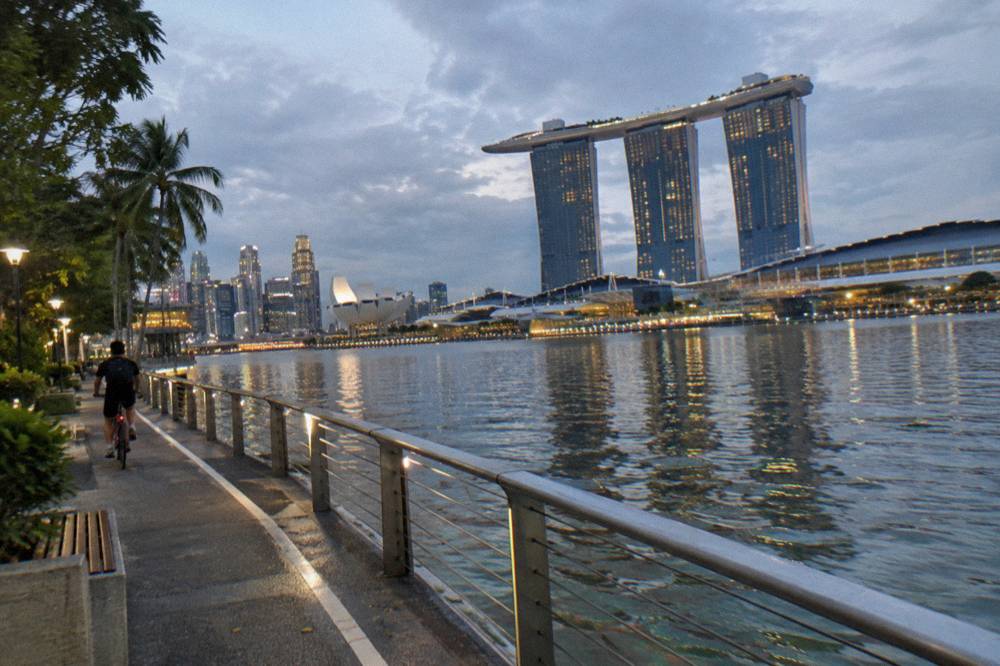
The night option deserves the push, because it solves the climate problem outright. Singapore after 7 pm drops toward the 25-degree range, the Marina Bay skyline does the rest, and the paths, lit along most urban stretches, are at their emptiest. The Marina Bay Night Ride runs two hours with a group cap of 15, includes bottle storage at the shop, a rain poncho if needed and bottled water, and carries 4.9 across 598 reviews.
For a first daylight ride, the structure of the Lion City Bike Tour is a good template even for riders who choose a different operator: four hours, a cap of 12 riders, a licensed local guide, bike and poncho included, rain or shine. At from $68.03 per person with a 5.0 rating across 6,579 reviews, it is the most proven option on this site, and the review pool is large enough that the rating means something.
Riders with more time should look at the food hybrid rides, which pair the path network with the thing Singapore does better than almost any city on earth. The Full-Day Private Ride, Food Included from Singapore City Explorers runs 7 to 8 hours from $224.11 per person with tastings, lunch, guide, bike, helmet and water included, and the shorter Bike and Bites, 3 hours from $79.24 per person, covers the same idea in a shared group. Both are best booked through the tour page rather than improvised.
A visitor planning a week or more should also look past the city proper. The Pulau Ubin cycling guide covers the island where the mountain bike trails sit, and the coastal rides overview stitches the eastern shoreline into one route. Neither needs a guide, but both reward one.
- Bike23 of 23
- Guide19 of 23
- Drinks14 of 23
- Helmet11 of 23
- Meal or food stop8 of 23
A listing that does not mention an item is not counted as leaving it out.
What About Renting Independently?
Renting works, and the bike rental guide covers where and how, but the honest comparison is that a guided tour costs little more than a day's rental plus a bad route decision. Bike-sharing in Singapore runs on the Anywheel and HelloRide apps, and its own rules, covered in the shared bikes guide, add designated-zone parking with a penalty fee for parking outside them. A tour absorbs all of that friction into one price and one meeting point. If you're still weighing whether renting on your own makes sense, the guide to renting bikes in Singapore as a visitor spells out the shop terms and rules you'd be signing up for.
The rides on this page run the full spread across the island, from two-hour night loops to full-day private food tours, and they cover the range that first-time visitors actually book.
Common Questions About Cycling In Singapore
Is Singapore Good For Cycling?
Yes. Singapore maintains over 350 km of park connectors plus dedicated cycling and shared paths around its main districts, a 75 km open phase of a planned 150 km Round Island Route, and mountain bike trails on Pulau Ubin. The trade-offs are equatorial heat, a November to January wet season, and rules that keep bicycles off Pedestrian-Only Paths.
Is It Safe To Cycle In Singapore?
Cycling paths and shared paths carry a 25 km/h limit and enforcement, footpaths 10 km/h, and helmets are mandatory on roads. The [MSS climate page](https://www.weather.gov.sg/climate-climate-of-singapore/) is the reference for heat planning, and nearly every guided tour here includes water and a poncho in the price.
Do You Have To Wear A Helmet In Singapore?
On roads, yes, it is mandatory, and enforcement against non-compliance has continued into 2026. On park connectors and shared paths a helmet is advised by NParks but not legally required. Most guided tours include one in the price or provide one on request.
Can Tourists Rent Bikes In Singapore?
Yes. Licensed bike-sharing operators run dockless bicycles through their apps with designated-zone parking, and rental shops operate at East Coast Park, Punggol and Pulau Ubin. A guided tour includes the bike in the price, which removes the rental counter entirely.
What Is The Best Month To Cycle In Singapore?
February is the driest month on the official 1991 to 2020 normals at 105.1 mm of rain across 8.5 rain days, and March and April follow it. November and December are the wettest at 252.3 and 331.9 mm. Morning and night rides work in any month.