When To Cycle In Singapore: Heat, Rain And Haze By Month
Singapore sits one degree north of the equator, so it never has a dry season and a wet season in the way temperate cities do. It has two monsoon swings instead, and the difference between a good ride and a soaked one is usually the month and the hour you pick.
Short answer
February is the driest month to cycle in Singapore, with about 105 mm of rain across roughly 8 rain days on the Meteorological Service Singapore 1991 to 2020 normals for Changi. December is the wettest at 332 mm across about 19 rain days. May is the hottest month at a 28.6 C daily mean, so early morning slots suit most riders.
Timing decides more of a Singapore ride than most visitors expect. The island is small, flat and threaded with park connectors, so the route is rarely the problem. The weather is. A cyclist who picks February and a 7 am start shares very little with one who picks a December afternoon, and the difference shows up in the official climate record, not in folklore.
When Is The Best Time To Cycle In Singapore?
The best time to cycle in Singapore is February, then September, when rainfall sits at its lowest on the Meteorological Service Singapore 1991 to 2020 normals for Changi and showers arrive in short bursts rather than long soakings. Of those, February is the standout: 105 mm of rain across about 8 rain days, with seven sunshine hours a day. Book morning slots either way, because midday heat is the same in every month.
The reason February works is the tail of the Northeast Monsoon. That monsoon runs from December to early March and dumps the year's heaviest rain in its first half, then fades. By February the wind has steadied, the daily downpours thin out, and the island gets its driest, sunniest stretch of the calendar. Riders who only have one travel window and can choose within it should know this pattern well: wettest in November to January, driest in February, then a drier Southwest Monsoon from June to September.
| Season | Months | Character for cycling |
|---|---|---|
| Northeast Monsoon | December to early March | Wettest at the start, driest at the tail; February is the best month of the year |
| First inter-monsoon | Late March to May | Hot, thundery afternoon showers; May is the hottest month |
| Southwest Monsoon | June to September | Drier on average, occasional haziness |
| Second inter-monsoon | October to November | Generally wetter than the first; November averages 252 mm of rain |
The whole year stays warm, which is the other half of the timing question. There is no cool month here. The coldest readings on the Changi normals, December and January at a 26.8 C daily mean, would count as a warm summer week in most of Europe. What changes month to month is rain: annual rainfall averages 2,113 mm across roughly 171 rain days, and the spread between the driest and wettest month is more than three to one. That spread, not temperature, is what a visitor should plan around.
It also matters what kind of rain each season brings. Inter-monsoon months tend toward convective showers: heavy, brief, and often in the afternoon, which a morning tour simply steps around. The peak Northeast Monsoon brings longer, steadier rain that can sit over the island for hours. A rider who understands that difference stops asking "will it rain" and starts asking "which kind of rain", and that is a much easier question to plan for. The operators whose tours appear on Singapore Bike Tours treat it that way too: several listings describe themselves as rain or shine activities and hand out ponchos or raincoats rather than cancel.
Which Months Are The Driest For Cycling In Singapore?
February is the driest month to cycle in Singapore, averaging 105 mm of rain over about 8 rain days and seven hours of sunshine a day on the Changi 1991 to 2020 normals. March and the June to August stretch form the next tier. November and December are the wettest, at 252 and 332 mm, so avoid those months if a dry ride matters and you have the flexibility to choose.
The full monthly picture comes straight from the official series. The Meteorological Service Singapore 1991 to 2020 normals for Changi, published alongside the agency's climate of Singapore reference, give every month's mean temperature, rainfall and rain-day count, and the table below compresses them to the columns a cyclist cares about. A rain day there is a day with 0.2 mm of rain or more, which in the tropics can mean one ten-minute shower rather than a washout.
| Month | Mean temp C | Mean daily max C | Rainfall mm | Rain days | Sunshine h/day |
|---|---|---|---|---|---|
| Jan | 26.8 | 30.6 | 221.6 | 13.4 | 5.8 |
| Feb | 27.3 | 31.5 | 105.1 | 8.5 | 7.0 |
| Mar | 27.8 | 32.2 | 151.7 | 12.1 | 6.3 |
| Apr | 28.2 | 32.4 | 164.3 | 14.9 | 6.1 |
| May | 28.6 | 32.3 | 164.3 | 14.5 | 6.0 |
| Jun | 28.5 | 31.9 | 135.3 | 13.2 | 5.8 |
| Jul | 28.2 | 31.4 | 146.6 | 13.6 | 6.1 |
| Aug | 28.1 | 31.4 | 146.9 | 13.8 | 6.0 |
| Sep | 28.0 | 31.6 | 124.9 | 12.5 | 5.4 |
| Oct | 27.9 | 31.8 | 168.3 | 15.0 | 5.0 |
| Nov | 27.2 | 31.2 | 252.3 | 19.0 | 4.4 |
| Dec | 26.8 | 30.5 | 331.9 | 19.3 | 4.3 |
Two readings of that table matter for booking. First, the "rain days" column is more honest than the rainfall column for a visitor. December's 331.9 mm over 19.3 rain days means sustained wet; February's 105.1 mm over 8.5 means most days stay dry. Second, sunshine hours fall off a cliff in November and December, down to 4.4 and 4.3 a day, which is the number behind the grey, heavy skies riders remember from year-end trips. The monthly mean air temperature series behind these figures is also available as an open dataset on data.gov.sg for anyone who wants the raw numbers.
What that means in practice: a February rider plans around heat, a December rider plans around rain, and the rest of the year sits between. The tours themselves barely change. The licensed guided rides around the civic district run the same routes in every month, and the same ponchos come out of the same boxes. Anyone matching a booking to the calendar should also skim the comparison of private versus group bike tours in Singapore, since group size and start time do more for comfort in a wet month than the route does.
How Hot Does Singapore Get On A Bike?
On the Changi 1991 to 2020 normals, Singapore's mean daily maximum never falls below about 30.5 C in any month and peaks near 32.4 C in April, while humidity averages 82 percent year-round, so heat rather than temperature alone is the daily constraint. May is the hottest month on the 28.6 C daily mean. Cyclists handle this by riding before 10 am or after 5 pm and drinking before they feel thirsty.
The heat deserves respect because the island removes the usual escape hatches. There is no winter cool-down, no elevation that drops the temperature, and the daily max barely moves: the entire monthly range of mean daily maxima, from 30.5 C in December to 32.4 C in April, is under two degrees. Media reports in late October and early November 2026 described daily maxima reaching 33 to 35 C on some days, and the Meteorological Service Singapore normals show the inter-monsoon months as the steadiest furnace of the year, so the planning advice is identical in every season: move the ride to the edges of the day.
- Jan222 mm
- Feb105 mm
- Mar152 mm
- Apr164 mm
- May164 mm
- Jun135 mm
- Jul147 mm
- Aug147 mm
- Sep125 mm
- Oct168 mm
- Nov252 mm
- Dec332 mm
Rain-days run from 8.5 (driest month) to 19.3 (wettest month).
Heat plus 82 percent humidity is what actually slows riders down, because sweat stops evaporating efficiently when the air is already saturated. The practical fixes are boring and effective: a slower pace, real water stops, and a guide who knows where the shade is. Guided rides build this in, which is one reason the format suits the climate better than ambitious self-planned distances.
| Riding slot | Typical conditions | Who it suits |
|---|---|---|
| Before 9 am | Coolest air of the day, low traffic noise, highest chance of clear skies | Long rides, photography stops, families, anyone sensitive to heat |
| 10 am to 4 pm | Peak heat and humidity, frequent convective showers in inter-monsoon months | Short shaded rides only, or indoor alternatives |
| After 5 pm | Temperature easing, showers mostly cleared on non-monsoon days | Food rides, sunset routes |
| After 7:30 pm | Cooler still, lit paths along Marina Bay and the riverfront | Night rides, city lights viewing |
Booking against that table is where a tour earns its price. A four-hour ride that starts at 8:30 am finishes before the worst of the midday, while a two-hour evening ride can dodge both heat and the afternoon shower window. Riders who run hot should also read up on what to wear cycling in Singapore, because fabric choice matters as much as start time in this humidity.
Why Are November And December The Wettest Months To Ride?
December sits inside the peak Northeast Monsoon, while November belongs to the second inter-monsoon period, when winds ease and thundery showers can build in the afternoon. Riding is still possible, but book morning slots, expect heavier and longer showers, and choose tours that supply ponchos and run rain or shine.
The Northeast Monsoon is the monsoon that matters here. From December to early March the prevailing wind swings round and carries moist air down the South China Sea, and the daily rain it drives is steadier and longer-lived than the pop-up afternoon thunderstorms of other months. November, the second inter-monsoon month, is nearly as wet as December, which has the fewest sunshine hours of the year. Together the two months account for over a quarter of the island's annual rainfall in under one sixth of the year.
That is not a reason to cancel a year-end trip. It is a reason to book differently. The rain in these months arrives in sustained spells rather than quick bursts, so a tour with indoor-flavoured stops, food tastings, heritage lanes and sheltered stretches, loses far less of its value than a long open-coast route would. The Katong Food Ride, Meal Included runs four hours with a licensed local guide, food stops and a max group of eight, from $96.05 per person, and its format bends naturally around a downpour. On the rainiest days even the cycling in the rain guide becomes essential reading rather than a curiosity.
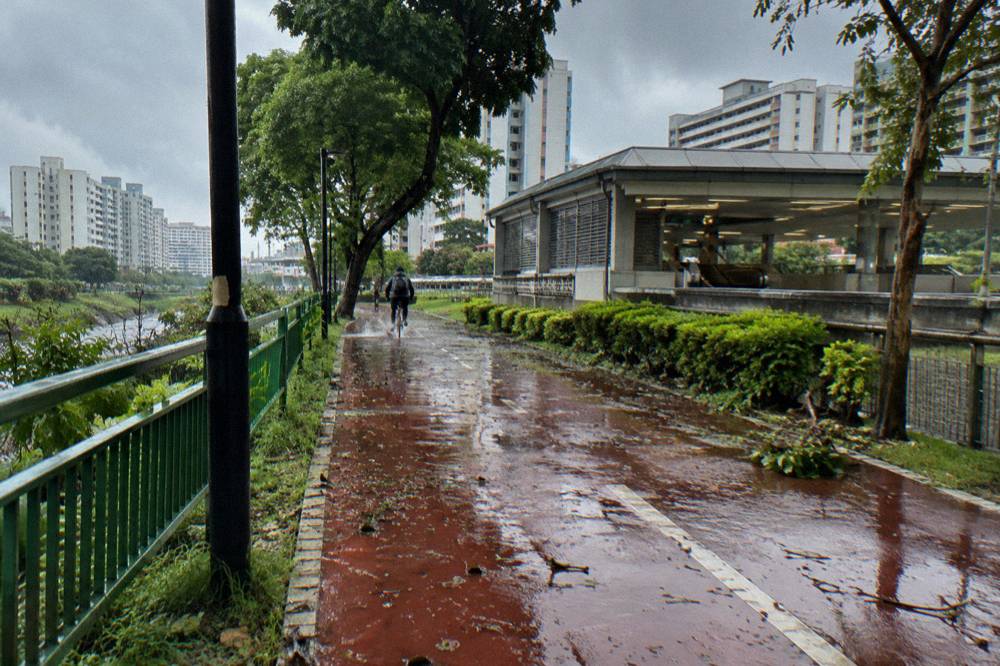
Operators themselves plan for this. Several listings describe themselves as rain or shine, including Lion City, Katong, Downtown, and the Heritage Highlights tour, and some include ponchos or raincoats, while free cancellation per the booking page means a genuinely unrideable forecast can usually be moved rather than lost. The phrase to look for when comparing options is not "weather proof", which no honest operator claims, but poncho included, helmet included and flexible start, which the night cycling in Singapore guide covers in more depth.
- Up to 2 hours4 tours
- 3 to 4 hours17 tours
- 5 to 6 hours1 tour
- 7 hours or more1 tour
What Time Of Day Is Best For Cycling In Singapore?
Early morning, roughly 7 to 9:30 am, is the best time of day to cycle in Singapore in every month, because the air is coolest, convective showers have not built up yet, and paths are quietest. Evening, after 5 pm, is the strong second choice and suits food and night rides. Midday is the worst slot: heat peaks and afternoon storms are most likely, especially from March to May.
The morning advantage has a physical cause. Singapore's showers are mostly convective: the sun heats the ground and the air above it through the morning, clouds tower up after lunch, and the rain dumps in the afternoon. Starting early means riding inside the window before the atmosphere destabilises. It also means the cleanest light for photographs and the coolest asphalt, which is not a small thing when the mean daily maximum never drops below 30.5 C.
One tour format is built around exactly this window. The Sunrise Ride, Local Breakfast starts at Punggol Field, runs three to four hours with a group capped at five, includes breakfast, bottled water, helmet and a souvenir, and starts from $48.02 per person, a low-cost pick for the heat-averse rider who wants the coolest hours of the day. It has a perfect rating across a small pool of 3 reviews, too new to mean much statistically, but the concept matches the climate science: ride first, eat after.
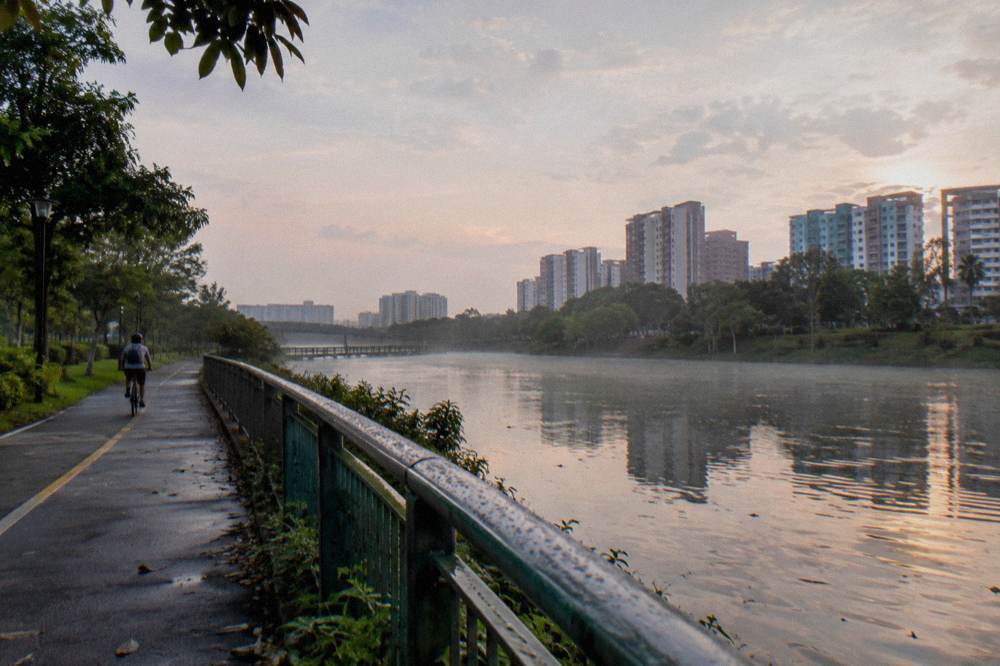
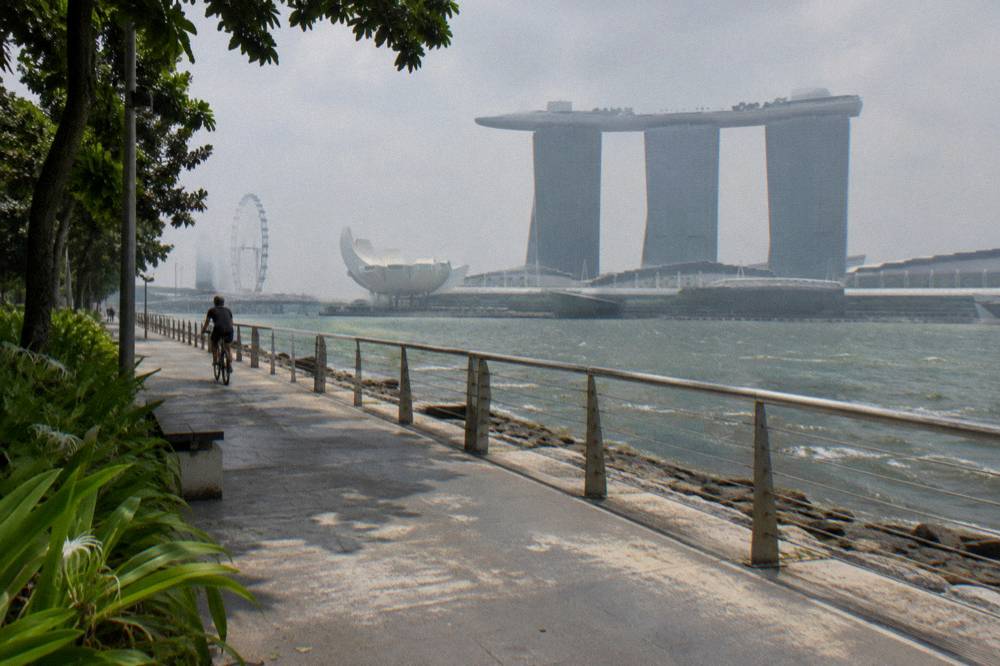
The evening slot earns its place for different reasons. Heat eases, the shower window closes, and the city switches on. The Marina Bay Night Ride, 2 Hours is the specialist here: a two-hour small-group loop capped at 15, from $48.02 per person, rated 4.9 across 598 reviews, with a licensed guide, helmet, bottled water and a rain poncho included. Riders who want the skyline rather than the sunrise should simply book this instead of the morning and sleep in.
The midday rule has one exception worth naming: the second half of the year. Rain can arrive at almost any hour rather than only the afternoon, so a clear morning does not always mean a dry ride later on. Local riders notice it, and the LTA and NParks guidance on path use, such as the NParks park connector etiquette pages, matters more than the clock when paths get busy at any hour. Visitors on a short trip should not gamble on the flip, though; the morning slot stays the safe pick.
Does Haze Change The Cycling Calendar In Singapore?
Yes, moderately. Haze in Singapore is a Southwest Monsoon phenomenon: the Meteorological Service Singapore notes that slight to moderate haze is common in the June to September season and in light-wind inter-monsoon months, and severe transboundary episodes can cut visibility below 1 km. Riders with asthma or breathing sensitivity should watch pollutant readings before booking from June through October and be ready to shift a ride indoors.
The honest framing is that haze is a real but intermittent risk, not a fixed season. Most years the June to September window passes with nothing worse than light haziness. December to March usually sees the least haze, as the Northeast Monsoon's rain clears the air. The years people remember, when regional land-clearing smoke sits over the island for weeks, are the exception, and they cannot be forecast a season ahead. Recent reporting into early November 2026 put the pollutant index in the moderate range with variable winds, which is the ordinary background state rather than an episode.
For a cyclist the practical readout is intensity, not date. Light haze changes a view, heavy haze ends a ride, and the pollutant index is published hourly by the authorities, so a same-day check is worth more than any month-by-month rule. Anyone booking during the Southwest Monsoon for a date weeks out should pick an operator with free cancellation per the booking page, so a bad air day costs a reschedule rather than the fare. The Singapore cycling rules for visitors page covers the rest of what changes day to day on the paths.
| Weather factor | Best months | Worst months | Planning move |
|---|---|---|---|
| Total rainfall | February, September | November, December | Book February first if flexible |
| Rain days | February, March | November, December | Prefer morning starts year-round |
| Heat | December, January | April, May | Ride before 10 am or after 5 pm |
| Sunshine hours | February, March | October to December | Accept grey skies late in the year |
| Haze risk | December to March | June to October | Check the pollutant index same-day |
Which Tours Fit Each Season In Singapore?
In the driest months, February and the June to August stretch, book the long four-hour city and heritage rides, since clear skies reward distance. In November and December, shift toward food-led and sheltered routes and short night rides, which lose the least to rain. The sunrise format suits the hot inter-monsoon stretch from March to May, when afternoon heat is the main constraint on any four-hour itinerary.
The Lion City Bike Tour of Singapore, a four-hour licensed guided ride with poncho included, a max group of 12 and a 5.0 rating across 6,579 reviews, from $68.03 per person, is the year-round benchmark, and its rain or shine design means the month matters less than the hour. The Full-Sized Bikes, Small Group ride from the same family of city tours runs four hours, caps at 15, includes a local snack and drink, from $64.03 per person and a 5.0 rating across 1,559 reviews. The Marina Bay Night Ride, 2 Hours, from $48.02 and rated 4.9 across 598 reviews, is the evening hedge for any month. All three offer free cancellation per the booking page, which is what makes seasonal optimism cheap.
- Small group13 of 23
- Private5 of 23
- Group type not stated5 of 23
Riders matching a specific tour to a specific month can use the table below as a starting grid. The prices are per-person starting figures in USD from each tour's listing, the total for group-size-dependent tours depends on group size, and the seasonal notes are the practical read of the climate table above, not operator promises.
| Tour | Duration | From, per person | Rating | Best seasonal fit |
|---|---|---|---|---|
| Lion City Bike Tour of Singapore | 4 hours | $68.03 | 5.0 across 6,579 reviews | Any month, morning start |
| Full-Sized Bikes, Small Group | 4 hours | $64.03 | 5.0 across 1,559 reviews | February, June to August |
| Marina Bay Night Ride, 2 Hours | 2 hours | $48.02 | 4.9 across 598 reviews | Year-round evenings |
| Sunrise Ride, Local Breakfast | 3 to 4 hours | $48.02 | 5.0 across 3 reviews | March to May heat |
| Katong Food Ride, Meal Included | 4 hours | $96.05 | 5.0 across 337 reviews | November, December |
| Bike and Bites, 3 Hours | 3 hours | $79.24 | 4.9 across 282 reviews | Wet months, food stop breaks |
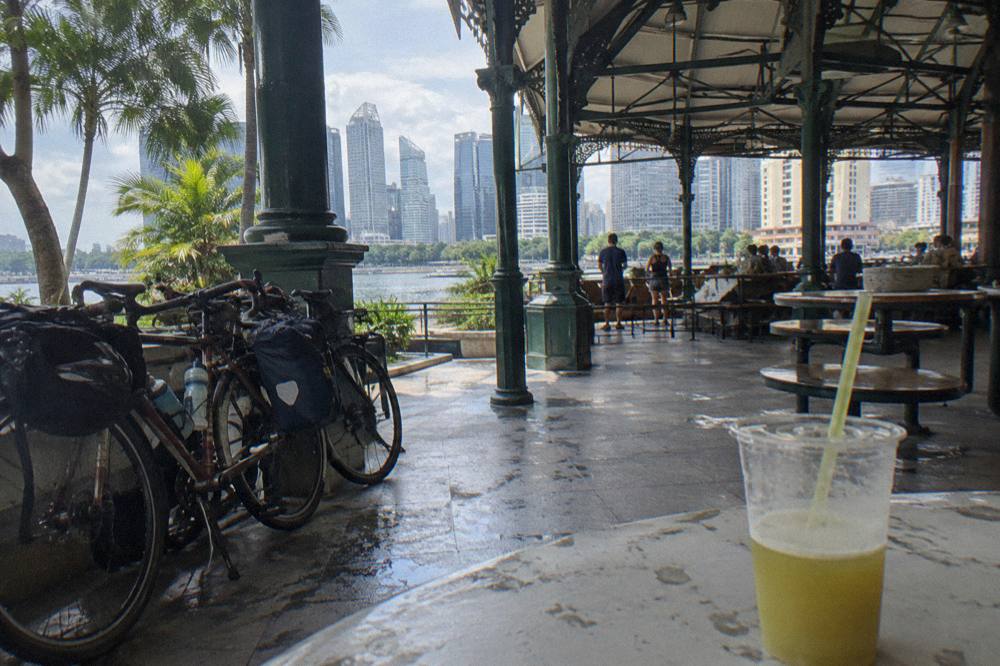
The food formats deserve their own word. The Bike and Bites, 3 Hours ride, from $79.24 per person and rated 4.9 across 282 reviews, mixes riding with shared local bites, and that structure is insurance against weather: an hour of rain costs one tasting stop, not the tour. The same logic applies to the Katong and Downtown food rides. Anyone whose trip lands in the wet window should weight their shortlist toward these and toward the hawker centres by bike routes, which string sheltered eating stops together.
What Should You Wear And Pack For Singapore Cycling Weather?
Pack for heat and rain in the same bag: light, breathable clothing that dries fast, sunscreen, sunglasses, a cap under the helmet, a refillable bottle, and a compact poncho or rain shell, because even February averages 8 to 9 rain days. Wear bright colours on road sections, take the helmet the operator provides, and leave cotton for the hotel, since 82 percent average humidity stops it drying.
- Bike23 of 23
- Guide19 of 23
- Drinks14 of 23
- Helmet11 of 23
- Meal or food stop8 of 23
A listing that does not mention an item is not counted as leaving it out.
The dress code barely changes across the calendar, which is the one gift the equatorial climate gives. A February morning and a July morning differ by under a degree on the daily mean. What changes is rain frequency, so the poncho moves from "polite" to "essential" from October to January. Operators know this and hand them out anyway: the Lion City Bike Tour includes a disposable poncho in its ticket, the 5-Hour Nature Ride includes one if raining, and the City Scoot small-group ride includes a raincoat, so the only rider who needs to bring their own is the one with standards about fit and reuse.
Footwear and storage are the small things that decide comfort. Closed shoes beat sandals on a pedal, a small dry bag protects phones during a squall, and the bag storage several operators offer at their shops means a backpack does not have to ride the whole route. Beyond that, standard NParks cycling guidance applies on park connectors: lights on at night, give way to pedestrians, and slow down where paths narrow. Nothing about the weather changes those rules.
Monthly Rainfall On The Changi 1991 To 2020 Normals
Mean rainfall in mm for selected months, driest to wettest
Common Questions About The Best Time To Cycle In Singapore
What Is The Best Month To Cycle In Singapore?
February. It is the driest month on the Meteorological Service Singapore 1991 to 2020 normals for Changi, with about 105 mm of rain across 8 to 9 rain days and seven sunshine hours a day, while still averaging a comfortable 27.3 C daily mean. June to August is the next best window.
Is It Too Hot To Cycle In Singapore?
It is hot year-round, with mean daily maxima between about 30.5 and 32.4 C and 82 percent average humidity, but not too hot to ride. Locals manage it by cycling before 10 am or after 5 pm, drinking steadily, and keeping distances modest. Midday is the slot to avoid in every month.
Can You Cycle In Singapore During The Rainy Season?
Yes. November to January averages 19 rain days a month, but several listings, including Lion City, Katong, Downtown, and Heritage Highlights, describe themselves as rain or shine, include ponchos, and offer free cancellation per the booking page. Prefer morning starts, shorter routes, and food-led formats with sheltered stops.
What Time Of Day Should I Book A Bike Tour In Singapore?
The early morning slot, roughly 7 to 9:30 am, is best in every month: coolest air, lowest shower risk and the quietest paths. Evening slots from 5 pm are the strong alternative and suit night rides along Marina Bay. Avoid midday starts, especially from March to May.
Does Haze Affect Cycling In Singapore?
Sometimes. The Meteorological Service Singapore notes that slight to moderate haze is common in the June to September Southwest Monsoon season and in light-wind inter-monsoon months, and severe transboundary episodes can cut visibility below 1 km. Check the pollutant index on the day and keep bookings flexible during that window.
Which Bike Tour Is Best If The Weather Is Uncertain?
A short or food-led ride. The Marina Bay Night Ride, 2 Hours is from $48.02 per person and rated 4.9 across 598 reviews, and the Bike and Bites, 3 Hours ride from $79.24 per person mixes riding with tasting stops, so a shower costs one stop rather than the itinerary. All tours listed here offer free cancellation per the booking page.