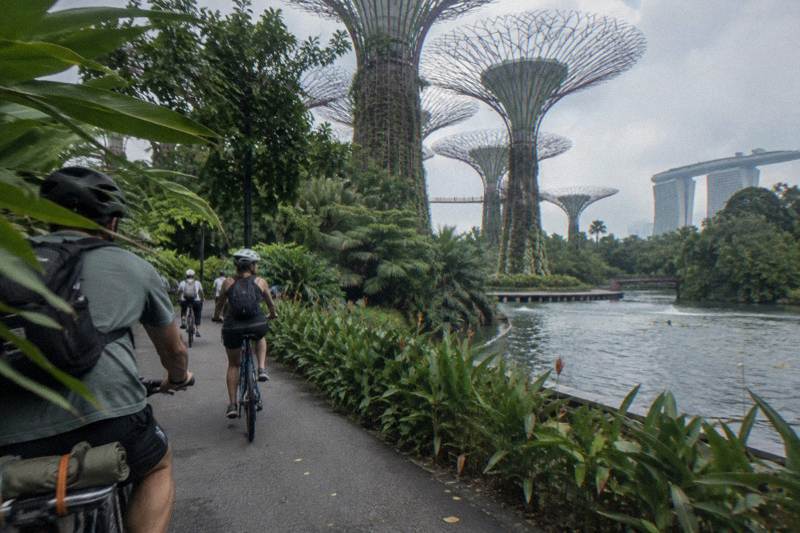
Taking A Bike On The MRT And Bus In Singapore
Singapore's trains and buses accept folded bikes under conditions the operators set, and most visitors never need to test them, because a guided tour hands you a bike at the meeting point.
Short answer
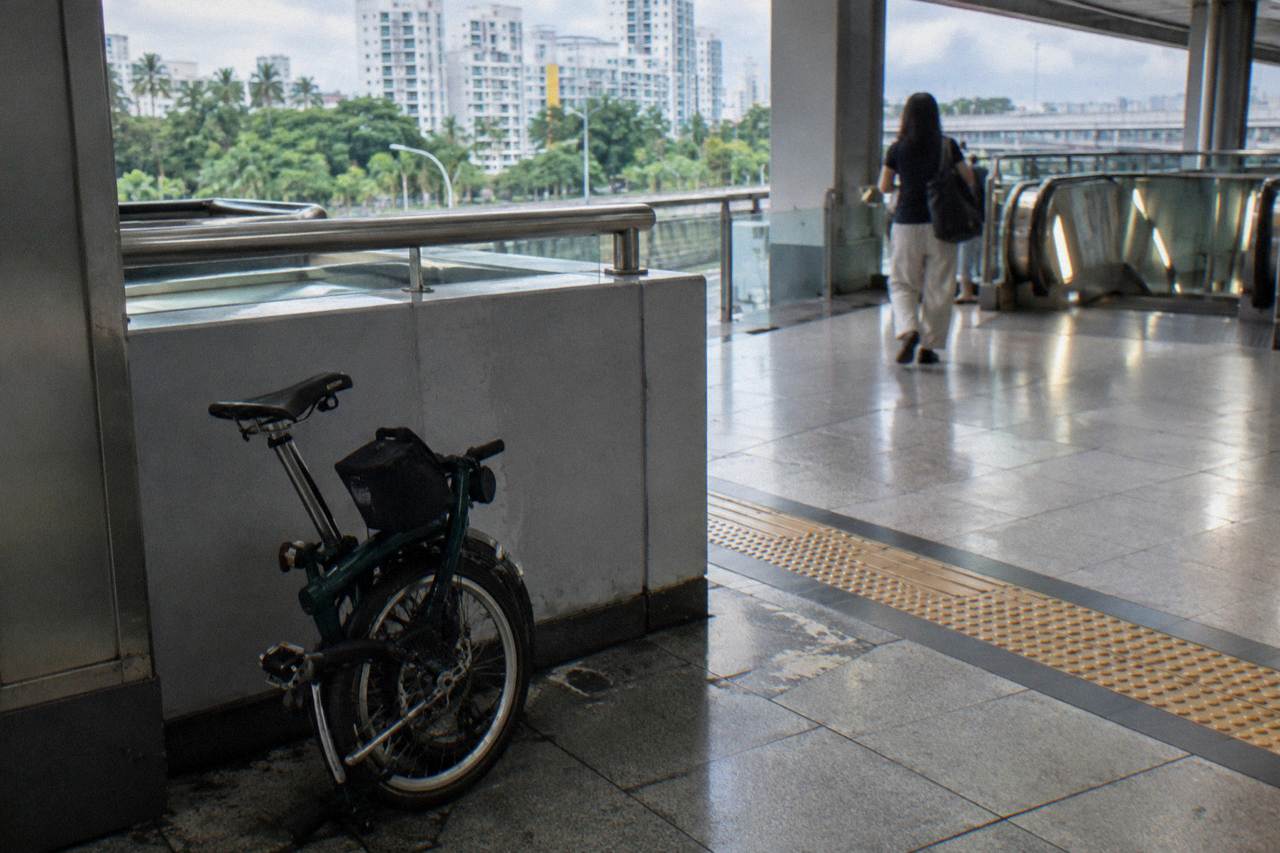
Full-size bicycles are generally not allowed on Singapore's MRT trains and buses. Foldable bikes ride along under conditions each operator sets, and the exact folded dimensions are operator policy, so the practical answer for visitors is simple: take transit to a tour meeting point and use the bike the tour supplies.
Full-size bicycles are generally not allowed on Singapore's trains and buses. Foldables ride along under conditions each operator publishes, and there is a third option most visitors miss: every guided tour on Singapore Bike Tours supplies the bicycle at the meeting point, which turns the transit leg from a rules problem into a simple commute.
Can You Take A Bike On The MRT In Singapore?
Yes, with a catch that decides everything: only a folded bike counts as luggage. Visitors should expect only folded bikes to be accepted on board, and should check each operator's carriage rules for the conditions that apply.
The Land Transport Authority sets the active mobility framework for paths and roads, while the rail and bus operators set carriage conditions for what riders may bring aboard. Those are two different rulebooks, and the distinction matters. Path rules cover where you may ride; carriage rules cover what you may carry. A bike that is legal to ride on a shared path at up to 25 km/h is still not welcome unfolded inside a train carriage during the morning peak.
For visitors, the honest summary is this. If you already own a foldable and you know its folded size, the operators' pages are the place to confirm the current conditions, because the specifics sit with them rather than in the active mobility statute. If you are renting for the day, the arithmetic usually collapses fast: a rental from a park kiosk stays near the park, and a guided tour supplies its own bikes. Neither plan asks you to fold anything.
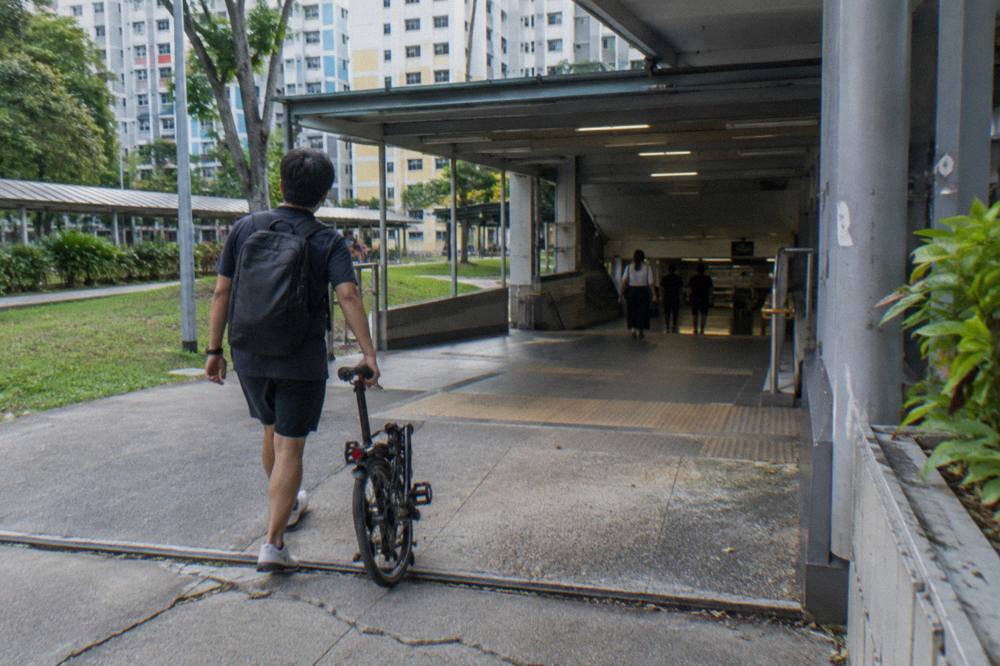
The general pattern across the operators is consistent even where the fine print is theirs to write: fold the bike, keep it clear of the doors, and expect crowded trains to make any large item unwelcome regardless of the letter of the policy. Peak hours on the downtown lines run dense. A folded frame that is polite at 10 am can be a genuine obstacle at 8 am, when the platform is at its most crowded.
One more practical note for anyone weighing the foldable route against the tour route. A foldable bike only pays off if you ride it at both ends of the train leg, which means you are riding on Singapore paths in Singapore weather, on your own route decisions, with no guide absorbing the route planning. Most visitors on a short stay get more value out of a guided four hours than out of the folding discipline a multi-leg commute demands. If you'd rather skip ownership questions altogether, our guide to renting bikes as a visitor in Singapore covers where to rent and what rules apply.
Which Bikes Are Allowed On Trains And Buses In Singapore?
Foldable bikes are the category the operators accept, subject to their own size and behaviour conditions, and those conditions are verified on the operator and authority pages rather than restated here. Unfolded bicycles, and any bike that cannot be carried as a single compact item, stay off the train and bus network.
The reason the specifics are not printed here is straightforward: the folded-dimension limits, any one-item-per-bus allowance, and the station size-checker details are operator policy, and repeating them secondhand risks being wrong by a centimetre. The right sources are the operators' own carriage pages and the authority's public transport guidance. What is stable is the category itself: foldable, folded, carried.
| Item | On trains | On buses | Where the conditions live |
|---|---|---|---|
| Foldable bike, folded | Accepted under operator conditions | Accepted under operator conditions | Operator carriage pages, checked before travel |
| Full-size bike, unfolded | Generally not allowed | Generally not allowed | Operator carriage pages |
| Shared bike from an app | Only if folded and compliant; operators expect returns to parking zones | Same as folded private bike | Operator pages, plus the app's zone rules |
| Guided tour bike | Handover at the meeting point | Handover at the meeting point | The tour's booking page |
The shared-bike row deserves a note. Singapore has two licensed shared-bicycle operators, and their bikes must be returned to designated parking zones, with a $5 penalty fee for parking outside them and bans for repeat offenders, per the Ministry of Transport's published reply on the scheme. That makes a shared bike a poor companion for a train leg: you would be renting one to leave it behind at a zone near the station anyway.
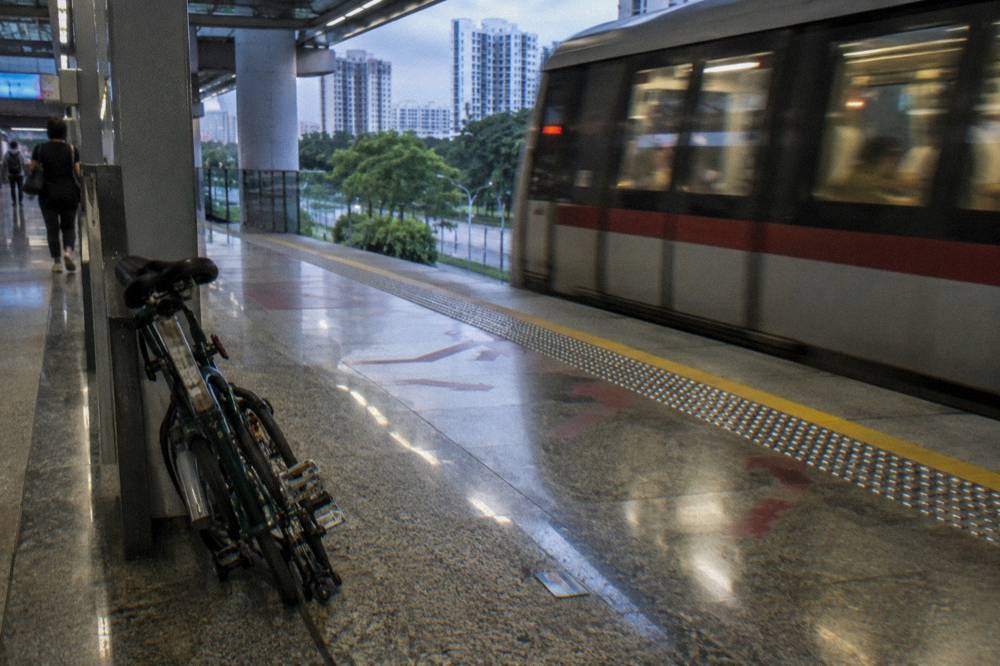
For planning purposes, the practical hierarchy is short. Riding your own route end to end beats folding, if the route is cyclable. A guided tour beats both for visitors, because the bike appears where the tour starts. Folding is the option for locals who already own the right frame, and they already know their operator's numbers.
How Do Guided Tours Remove The Need To Carry A Bike?
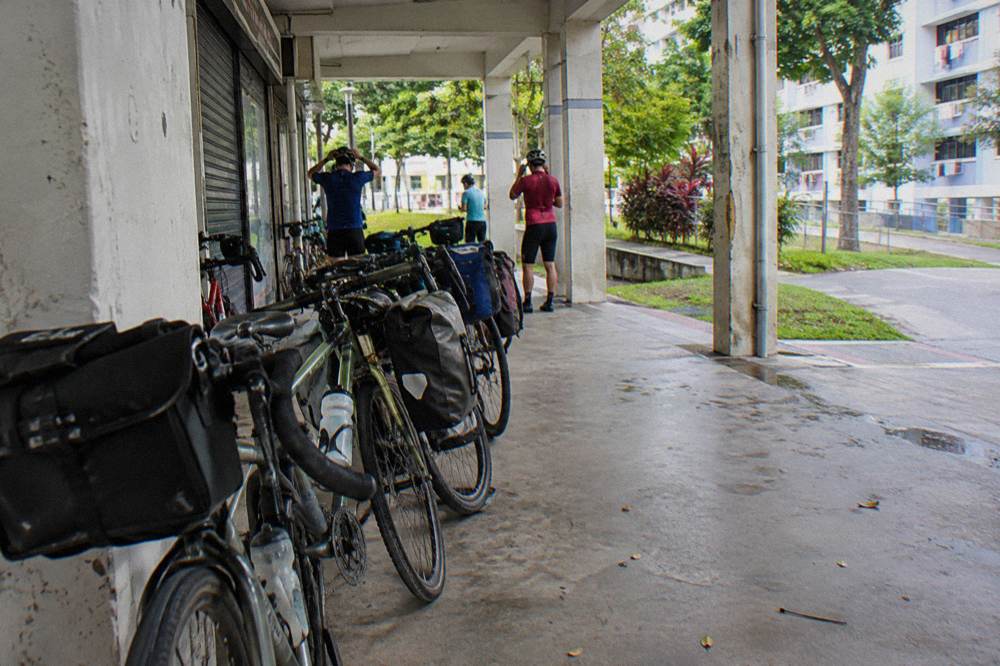
Every tour covered here includes the bicycle in the price, so the MRT ride to the meeting point is the only transit a rider makes. The bike, and in most cases a helmet, water and a rain poncho, arrive with the guide, which means the foldable-bike question never arises for the day's riding itself.
This is the quiet advantage of the guided format, and it deserves a full sentence rather than a footnote. A visitor who books a city ride does not rent, fold, carry, guard or return anything. The tour's own fleet is at the meeting point, sized during the check-in that most listings ask riders to arrive early for, and surrendered when the ride ends. Transit before and after is just transit.
The featured option in that selection is the Licensed Guide, Poncho Included city ride from Bike Around Tour Singapore: four hours, from $68.03 per person, rated 5.0 across 6,579 reviews, which makes it by a wide margin the most reviewed ride on the site. A comparable alternative is the Full-Sized Bikes, Small Group ride from Lets Go Tour Singapore, four hours, from $64.03 per person with the total depending on group size, rated 5.0 across 1,559 reviews. The format contrast is the Marina Bay Night Ride, two hours, from $48.02 per person with the total depending on group size, rated 4.9 across 598 reviews.
| Tour | Duration | Price basis | Reviews |
|---|---|---|---|
| Licensed Guide, Poncho Included | 4 hours | From $68.03 per person | 5.0 across 6,579 reviews |
| Full-Sized Bikes, Small Group | 4 hours | From $64.03 per person, total depends on group size | 5.0 across 1,559 reviews |
| Marina Bay Night Ride, 2 Hours | 2 hours | From $48.02 per person, total depends on group size | 4.9 across 598 reviews |
All three allow free cancellation per their listings, which matters for a plan built around a train timetable: hold the slot, then firm up the arrival time. The two Lets Go Tour rides both note no hotel pickup on their pages, which is exactly why the meeting-point-versus-station question in the next section is worth five minutes of planning.
Where Do The Tours Meet Relative To MRT Stations?
Meeting points cluster near rail stations and familiar landmarks rather than at hotel doors, and none of the city tours lists hotel pickup. The practical plan is a train ride to the nearest station, a short walk, and a check-in that several listings ask you to reach 15 to 20 minutes early for bike fitting.
The Katong Food Ride, Meal Included tour makes the pattern explicit: it meets at Dakota MRT Station itself, so the last leg is the station exit. The two Esplanade-based rides from City Scoot meet at Esplanade Mall, beside the Esplanade and City Hall stations' catchment. One heritage ride meets at the Indian Heritage Centre in the Little India area. The operator shopfronts on North Bridge Road and Republic Avenue sit within easy walking distance of the downtown stations.
The bike-supply point bears on the whole day, so it is worth stating plainly. Arriving by MRT means no parking decisions, no lock, no rental return window, and no ferry timing unless the tour itself includes one. The Pulau Ubin rides split their meeting points: two gather at Changi Point Ferry Terminal, while one meets on the island itself, so reaching that one adds its own transit leg, a bus or train to the terminal and a short bumboat crossing before the ride begins.
The Katong ride itself runs four hours, from $96.05 per person, rated 5.0 across 337 reviews, with snacks and foods included and a licensed local guide. For a visitor staying downtown, that is a single train ride to Dakota and a food-focused route out to the east coast neighbourhoods. The check-in detail on several listings is worth building into the plan: arrive early, because bike fitting and a safety briefing happen before the wheels move, and the group cannot wait for a late train.
- Bike23 of 23
- Guide19 of 23
- Drinks14 of 23
- Helmet11 of 23
- Meal or food stop8 of 23
A listing that does not mention an item is not counted as leaving it out.
What Rules Apply Once You Roll Out Of The Station?
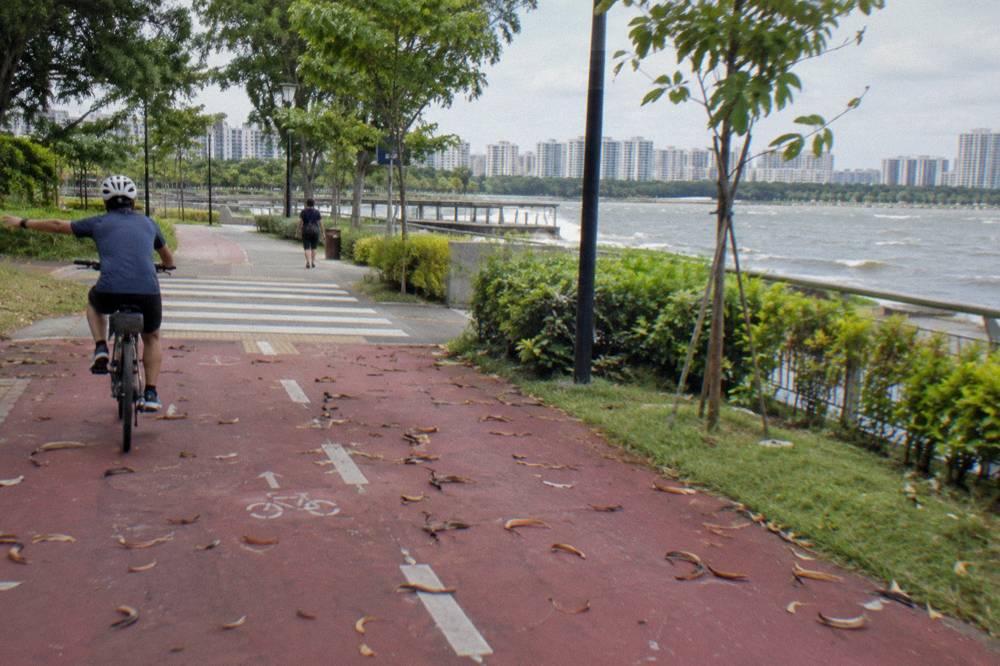
Once the tour bike is under you, the path rules take over: 25 km/h on cycling paths and shared paths, 10 km/h on footpaths, and no bicycles at all on paths converted to Pedestrian-Only Paths since 1 July 2025. Helmets are mandatory on roads and advised on park connectors, and the guide handles the route choices.
The path-type system is simple enough to learn in one table, and the authority's own materials organise it exactly this way. The limits below come from the authority's current "where devices are allowed" guidance.
| Path type | Marking | Speed limit | Bicycles |
|---|---|---|---|
| Cycling path | Red or dark grey, cyclist logo | 25 km/h | Allowed |
| Shared path | Cyclist and pedestrian logos | 25 km/h | Allowed |
| Footpath beside roads and in estates | Unmarked | 10 km/h | Allowed unless converted |
| Pedestrian-Only Path, next to a cycling path | Pedestrian signage | Not applicable | Not allowed |
| Road, excluding expressways and tunnels | Road signage | Road speed limit | Allowed, helmet mandatory |
The Pedestrian-Only Path conversion deserves a line of explanation, because it is new enough that older blog posts miss it. Since 1 July 2025, footpaths that run next to dedicated cycling paths have been converted to pedestrian-only use across parts of the island, with enforcement active and penalties of up to $2,000 and/or three months for first offences on those specific paths. A guided tour makes this a non-issue, since the guide's route is chosen to keep the group on legal surfaces.
On a guided ride the etiquette layer is handled for you, but knowing it makes the ride smoother: give way to pedestrians, slow at the red-dotted attention zones the park connector network marks near bus stops and playgrounds, keep left, and walk the device wherever a No Riding sign stands. The National Parks Board's etiquette pages cover the connector behaviour in full.
Does The Weather Change The Transit-Plus-Tour Plan?
It changes the timing, not the plan. Singapore runs hot and humid year-round with a wetter stretch from November to January, so the train-to-meeting-point pattern stays sound in every month, and what shifts is the hour you choose to ride and how seriously you take the poncho that most tours hand you.
- Jan222 mm
- Feb105 mm
- Mar152 mm
- Apr164 mm
- May164 mm
- Jun135 mm
- Jul147 mm
- Aug147 mm
- Sep125 mm
- Oct168 mm
- Nov252 mm
- Dec332 mm
Rain-days run from 8.5 (driest month) to 19.3 (wettest month).
The climate record behind that is the Meteorological Service Singapore 1991 to 2020 normals for Changi. May is the hottest month on a 24-hour mean of 28.6 C, December and January the coolest at 26.8 C, and the November to January window is the wettest, with December averaging 331.9 mm of rain across 19.3 rain days. February is the driest month on the same record.
| Month | Mean temp C | Mean daily max C | Rainfall mm | Rain days |
|---|---|---|---|---|
| February | 27.3 | 31.5 | 105.1 | 8.5 |
| May | 28.6 | 32.3 | 164.3 | 14.5 |
| July | 28.2 | 31.4 | 146.6 | 13.6 |
| October | 27.9 | 31.8 | 168.3 | 15.0 |
| November | 27.2 | 31.2 | 252.3 | 19.0 |
| December | 26.8 | 30.5 | 331.9 | 19.3 |
The relevance to a transit-plus-tour day is direct. A tour start reached by train is a start reached dry, and a tour that supplies a poncho, which most inclusions lists here do, absorbs the afternoon shower that the rain-day counts make routine. Riders who want the cool air book the night formats instead, which is one reason the two-hour Marina Bay Night Ride pairs so well with a train arrival.
Which Tour Formats Pair Well With A Transit Leg?
Any tour that starts near a rail station pairs well, and the strongest fits are the short evening rides: a two-hour night loop lets you arrive by train, ride in the cool of the evening, and be back at the station before late dining. Longer food and full-day formats reward the same arrival trick with a bigger payoff.
The two-hour formats are the purest transit pairing. The River Route via F1 Track ride from City Scoot, two hours, from $47 per person, 14 reviews on its page, meets at Esplanade Mall and loops the river and bay. The Marina Bay Night Ride covers similar ground at dusk. Both end where they began, so the return train is a short walk away.
- Up to 2 hours4 tours
- 3 to 4 hours17 tours
- 5 to 6 hours1 tour
- 7 hours or more1 tour
The food formats add a meal to the same arrival pattern. The Bike and Bites, 3 Hours ride from Lets Go Tour Singapore, from $79.24 per person with the total depending on group size, rated 4.9 across 282 reviews, is billed as shared local bites rather than a full meal. The Downtown Food Ride, Meal Included, four hours, from $104.05 per person, rated 5.0 across 92 reviews, leans further into eating.
The full-day private format is the outlier: 7 to 8 hours, from $224.11 per person, from Singapore City Explorers, with nine reviews on its page and food tasting, lunch and a local guide included. A day of that length makes the arrival-by-train trick more valuable, not less, since you arrive unfatigued and spend nothing of the day on logistics.
Private formats in general shift the transit question toward the operator rather than the timetable; the Private City Ride, 4 Hours, from $160.08 per person with the total depending on group size, 17 reviews on its page, starts on North Bridge Road in the downtown core.
- Small group13 of 23
- Private5 of 23
- Group type not stated5 of 23
What About Bikes, Ferries And Other Transits In Singapore?
The one transit leg in the tour set that a foldable bike cannot cover is the Pulau Ubin crossing, and the Ubin tours handle it either by including the ferry or by meeting you at Changi Point Ferry Terminal. Ferry fares, crossing times and boat capacity are not printed here, because they are the operators' and ferry operators' details to confirm on the day.
The Ubin rides are the clearest case of a tour absorbing a transit problem. The Private Pulau Ubin Ride, from $96.05 per person, rated 5.0 across 153 reviews, includes a skip-the-queue return island ferry and a refreshment, meeting at Changi Point Ferry Terminal. The Ubin Heritage Ride, Meal Included, from $195 per person, a new listing without reviews yet, includes return bumboat transportation plus a simple local meal and drink.
The island itself is a protected, low-key place: the National Parks Board reports a mountain bike park of 45 hectares with roughly 10 km of trails rated against international standards, and its notices pages carry the current closures. Cyclists there are asked to dismount on steep slopes and to rent or bring a helmet. A guided ride keeps a visitor inside all of that comfortably.
For riders who want to combine a self-planned transit leg with a guided day, the Singapore Cycling Routes guide and the Park Connector Network overview cover the path network the tours use, while the Pulau Ubin cycling guide covers the island end. The bike rental options guide exists for the day you want a bike without a guide, and that is the one scenario where the folding rules start to matter again.
One newer option rounds out the set: the Bikeable City Ride from LC Travel Planners, four hours, from $64.03 per person, a new listing with no reviews yet, meeting at The Bicycle Hut with a licensed English-speaking guide and a helmet included. New listings carry no rating history, so the honest framing is exactly that sentence, plus whatever the booking page shows on the day.
The short version of the whole page: arrive by MRT, ride a tour's bike, and hand it back. The foldable-bike rules are real and worth knowing, but they belong to the rider who already owns the frame, and that rider already knows where to check the current dimensions.
Common Questions About Taking A Bike On The MRT And Bus In Singapore
Can You Take A Full-Size Bike On The MRT In Singapore?
Generally no. The rail and bus operators treat an unfolded bicycle as a vehicle rather than a passenger item, so only foldable bikes travel aboard, folded, under each operator's own carriage conditions.
What Are The Folded Size Conditions For Bikes On Trains And Buses?
Those specifics are operator policy rather than active mobility law, and they are verified on the operators' own carriage pages and the authority's guidance rather than repeated secondhand here. The stable category is: foldable, folded, carried as one item.
Do Guided Tours In Singapore Include The Bicycle?
Yes, every tour covered here includes use of a bicycle in the price, and most add a helmet, water and a rain poncho on their inclusions lists. You take transit to the meeting point and the bike is there.
Where Do The City Bike Tours Meet?
At operator shopfronts and landmarks near rail stations: North Bridge Road, Republic Avenue, Esplanade Mall, the Indian Heritage Centre, and for one food ride, Dakota MRT Station itself. None of the city tours lists hotel pickup.
Is A Helmet Required For Cycling In Singapore?
On roads, yes, for riders and pillion passengers alike. On park connectors the parks authority advises a helmet, and most tours either include one or provide one on request, per their listings.
Can You Bring A Shared Bike From An App Onto The MRT?
In principle only if folded and compliant, but in practice the shared-bike scheme expects trips to end at designated parking zones, with a $5 penalty for parking outside them and bans for repeat offenders. A shared bike is a poor companion for a train leg.